Parts of this page were generated by AI.
Resources
“The brand is an integral part of the luxury product and experience, the name which concentrates the dream.” (Kapferer, 2012)
Luxury Branding
Luxury marketing operates on fundamental principles that directly oppose traditional mass-market marketing. Rather than responding to consumer demand, maximizing volume, or competing on functional utility, luxury branding focuses on creating desire, managing rarity, and building symbolic value.
Overview of the Luxury Market
The global luxury market is dominated by major luxury conglomerates that manage portfolios across apparel, leather goods, jewelry, watches, and beauty.
Top Global Luxury Players
According to Deloitte’s Global Power of Luxury Goods (2026), the top luxury conglomerates account for the vast majority of market growth:
- LVMH Moët Hennessy-Louis Vuitton SE (France) – Accounts for ~31% of Top 10 sales
- Kering SA (France) – Gucci, Saint Laurent, Bottega Veneta
- Compagnie Financière Richemont SA (Switzerland) – Cartier, Van Cleef & Arpels
- The Estée Lauder Companies (US)
- Chanel Limited (UK)
- L’Oréal Luxe (France)
- Chow Tai Fook Jewellery Group Limited (Hong Kong)
- Hermès International SCA (France)
- Rolex SA (Switzerland)
- PVH Corp. (US)
The Top 10 luxury companies generate over 63% of the total sales growth among the Top 100 players.
The 6 Main Attributes of Luxury
Luxury products and services are defined by six core characteristics:
- High Quality: Exceptional craftsmanship, performance, design, and attention to detail.
- High Price: Offered at a price point that far exceeds mere functional value.
- Heritage, Tradition, and Culture: Rooted in a founder’s story, historical know-how, and geographic origin (e.g., Ferrari’s ties to Enzo Ferrari and Maranello, Italy).
- Restricted & Controlled Distribution: Purposefully limited availability to preserve exclusivity.
- Personalized Services: High-touch, customized customer experiences (e.g., bespoke ateliers, personal advisors).
- Privilege, Desire & Emotion: Evoking a sense of exclusivity for the owner while creating aspirational desire in others.
Segmenting Luxury
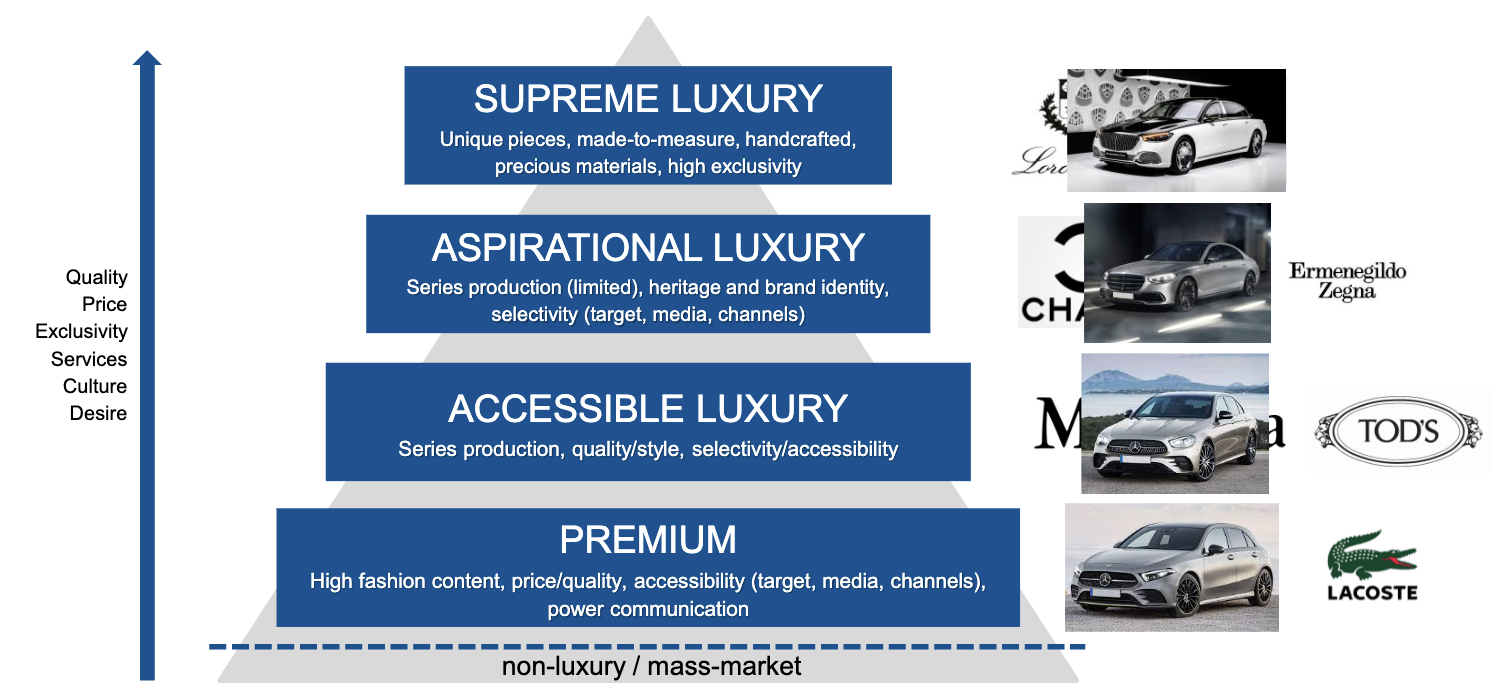
Luxury is highly subjective and varies significantly across demographic groups and cultures. To prevent brand erosion, luxury offerings are segmented into distinct tiers based on price, quality, craftsmanship, and exclusivity.
| Luxury Tier | Key Characteristics | Examples |
|---|---|---|
| Supreme Luxury | Unique, handcrafted, made-to-measure, precious materials, extreme exclusivity. | Chanel Haute Couture, bespoke hypercars |
| Aspirational Luxury | Limited series production, strong heritage, high selectivity in target and channels. | Luxury watches, iconic leather bags |
| Accessible Luxury | Series production, high quality/style, higher accessibility. | Designer eyewear, luxury fragrances |
| Premium / Upper-Range | High fashion content, strong price/quality ratio, broad accessibility. | Upper-market fashion brands |
Multi-Tier Portfolio Confusion
High-end houses often operate across multiple luxury segments simultaneously. For example, Chanel sells Supreme Luxury in its couture collections, Aspirational Luxury in watches and handbags, and Accessible Luxury in sunglasses and cosmetics. Confusing upper-range premium goods with true luxury risks diluting brand aura.
The Luxury Consumer
True luxury consumers (spending an average of ~€360k annually on luxury goods) are driven by two distinct psychological motivations:
- Luxury for Others (Ostentatious / External): Driven by self-signaling wealth, status, and social standing. The brand holds a position of perceived superiority relative to the buyer.
- Luxury for Oneself (Hedonistic / Internal): Driven by personal pleasure, emotional fulfillment, and self-esteem (Belk, 1985/1988). The consumer values the intrinsic sensory and emotional experience.
Luxury Brand Identity & Equity
Unlike mass-market products where raw material costs dictate pricing, luxury value resides primarily in brand aura and symbolic equity.
Brand Identity vs. Positioning
In traditional marketing, brands rely on competitive positioning (Points of Parity vs. Points of Difference). In luxury, brands do not compete on comparative positioning; instead, a luxury brand proposes a world of its own based on Kapferer’s Brand Identity Prism.
Modes of Luxury Brand Building
Luxury houses build their identity through two distinct historical approaches:
- History Mode (European Approach): Focuses on product value, deep craftsmanship, creator heritage, and iconic staple products (e.g., Hermès, Chanel, Salvatore Ferragamo).
- Storytelling Mode (American Approach): Focuses on brand personality, experiential retail environments, client storytelling, and VIP culture (e.g., Marc Jacobs, Tory Burch).
Luxury Brand Equity & The Dream Equation
Luxury brand value rests on intangible symbolic power rather than raw functional utility. Dubois & Paternault (1995) formalized this through the Luxury Dream Equation:
The Luxury Dream Mechanism
A luxury brand’s dream value increases with widespread public awareness (), but decreases with the rate of actual purchase/ownership ().
To maintain a strong luxury dream, the distance between the number of people who recognize the brand and those who can actually afford/own it must remain wide.
Brand Value vs. Revenue Comparison
A strong luxury brand commands immense brand equity relative to its annual sales volume:
- Hermès (2025 Revenue: 133.4B) Brand value is >8x annual revenue.
- H&M (2025 Revenue: 7.2B) Brand value is ~0.3x annual revenue.
Dimensions of Luxury Customer Experience
Consumer experience directly enhances perceived brand equity (Batat, 2019) across four dimensions:
- Sensory Experience: Multi-sensory delight (tactile materials, signature store scents, aesthetics).
- Emotional Experience: Feeling privileged, unique, and emotionally elevated.
- Relational Experience: Highly personalized service, feeling part of an exclusive club.
- Cognitive Experience: Acquiring specialized knowledge and becoming a connoisseur of the brand.
Brand Authenticity
According to Beverland (2005), luxury brand authenticity relies on six key pillars:
- Heritage & Pedigree: Historical continuity and founder narrative.
- Stylistic Consistency: Unwavering visual and design identity over time.
- Quality Commitments: Uncompromising standards of materials and execution.
- Relationship to Place: Geographic connection (e.g., Made in Maranello / Paris).
- Method of Production: Artisanal craftsmanship and traditional techniques.
- Downplaying Commercial Motives: Presenting passion and art over profit seeking.
Brand Extension vs. Brand Stretching
When entering new product categories, luxury houses choose between two expansion paths:
- Brand Extension: Implementing the true luxury strategy in a new domain.
- Drivers: High perceived brand fit (Hagtvedt & Patrick, 2008) and high hedonic potential (Hagtvedt & Patrick, 2009).
- Outcome: Preserves brand style, identity, and luxury status without diluting exclusivity.
- Brand Stretching: Applying a fashion or premium (mass/diffusion) strategy rather than a luxury strategy in a new category.
- Drivers: Rapid short-term growth in revenue, licensing fees, and mass awareness.
- Risks: Undermines luxury distance, dilutes perceived quality, fragmentizes brand discourse, and risks loss of brand control.
Luxury and Art (“Artification”)
Luxury brands frequently blend with the art world to elevate their symbolic status—a process known as artification.
The M(Art) Worlds Framework (Joy et al., 2014)
Luxury flagship stores increasingly function as modern art institutions, characterized by:
- Architectural Masterpieces: Luminous, open spatial design.
- Product as Artwork: Displaying sparse product lines like gallery exhibits.
- Sales Staff as Curators: Educating clients on product provenance and authenticity.
- Consumers as Collectors: Reframing purchasing as art acquisition.
- Subtle Intimidation: Maintaining distance and awe to reinforce exclusivity.
The Anti-Laws of Marketing (Kapferer)
Traditional marketing techniques (e.g., consumer testing, price promotion, volume distribution) can destroy luxury brand equity. Kapferer established 15 Anti-Laws of Luxury Marketing:
- Forget about ‘positioning’: Luxury is not comparative; focus on absolute uniqueness rather than comparing to rivals.
- Do not pander to customers’ wishes: Maintain firm brand vision and historical consistency rather than following market trends.
- Ensure your product has enough ‘flaws’: Embrace artisanal character, handcrafted traits, and uniqueness over standardized perfection.
- Do not respond to rising demand: Deliberately restrict supply to preserve rarity and long-term desire.
- Do not relocate your factories: Keep production steeped in the brand’s original culture and country of origin.
- Ensure the imagined price is higher than the real price: Elevates the brand’s aura of luxury.
- Luxury sets the price; price does not set luxury: Price is a consequence of luxury equity, not an input.
- Raise prices over time to increase demand: Reverses standard economic demand curves by enhancing status signaling (Veblen effect).
- Keep raising the average price of the product range: Continually elevates the overall brand tier.
- Do not look for cost reduction: Focus value creation on maximizing added value rather than cutting production costs.
- Do not sell (avoid volume strategies): Avoid aggressive sales pitches; let customers seek out the brand.
- Advertising is not meant to sell: The primary role of advertising is to build long-term dream value, not drive immediate transactions.
- Communicate to non-targets: Ensure non-buyers recognize the brand so buyers achieve status recognition.
- Make it difficult for clients to buy: Inaccessibility (waiting lists, boutique hurdles) intensifies desire.
- Sell only marginally on the internet: E-commerce eliminates physical retail atmosphere, personal relationships, and exclusive club feel.