Hand-crafted by Flo, auto-checked by AI.
Resources
“The study of the processes involved when individuals or groups select, purchase, use, or dispose of products, services, ideas, or experiences to satisfy needs and desires.” (Solomon et al.)
Consumer Insights
Consumer insights are not just data, but actionable insights to understand users of a product, and how they behave. They help brands design better messages and products, improve targeting and personalization, and reduce risk in product decisions.
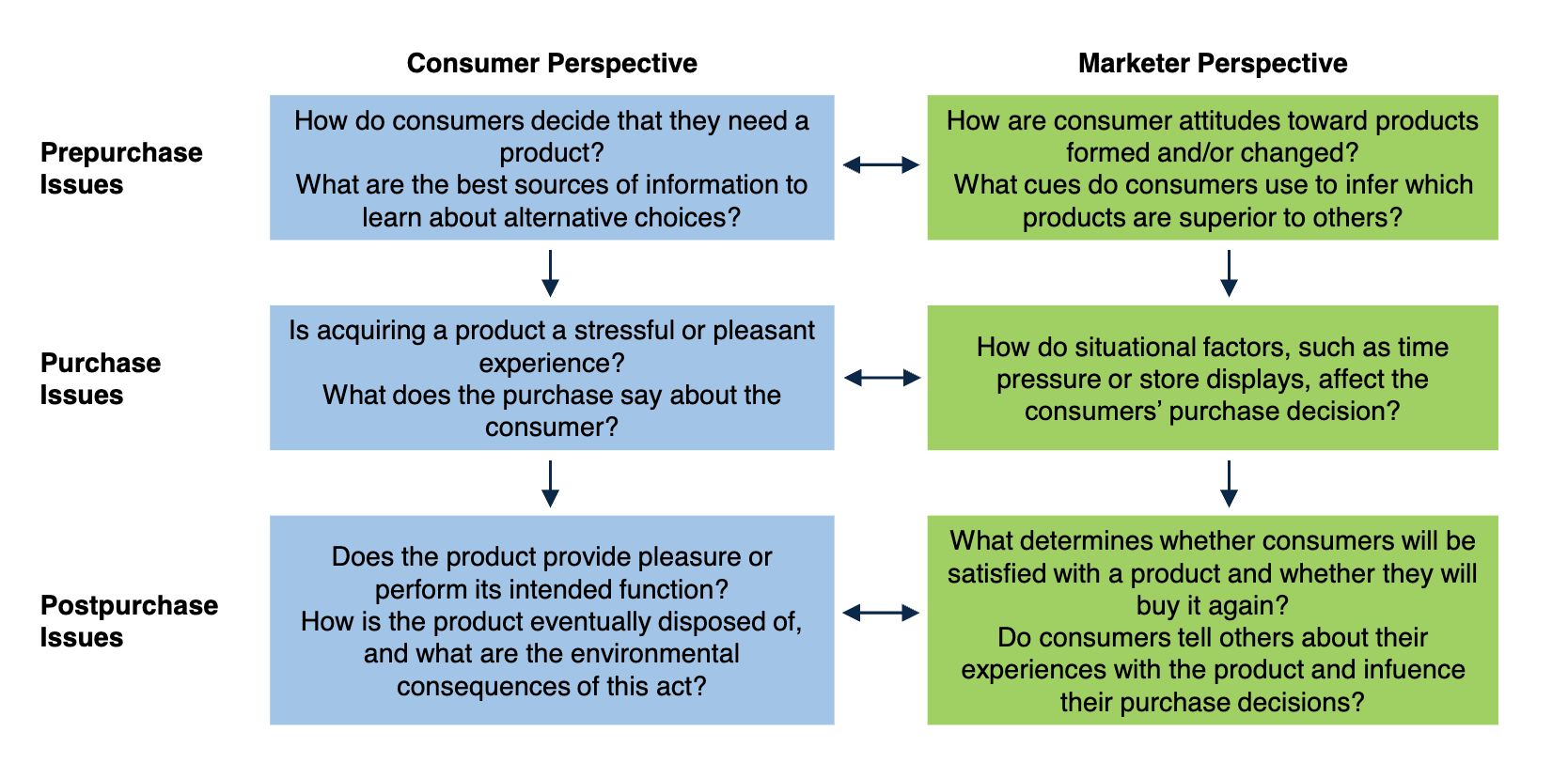
Consumer behavior is influenced by situational influences, psychological influences, and social influences.
Situational Influences
Situational influences derive from circumstance, times, or places. This includes a person’s mood, available time, reason for purchase, external influences, and physical surroundings.
Psychological Influences
Psychological influences are internal factors that help in determining people’s behavior. This includes the perception of the brand, learning and memory, motivation, and the person themself.
Perception
A brand or product can be perceived through the different human sensors:
- Vision: Colors have certain associations. Yellow–Optimistic&Clear, Orange–Friendly&Confident, Red–Excited&Youthful, Purple–Creative&Wise, Blue–Trust&Strength, Green–Peace&Health, Gray–Balance&Calm
- Sound: Most companies have recognizable sound logos to make use of the powerful memory trigger
- Touch: Most commonly perceived in the purchase stage, and can be used to create a more luxurious experience.
- Taste: Similar to touch, but more commonly used in the food industry.
Exposure, Attention, Interpretation
- Exposure is the degree to which people notice a stimulus within their range. It’s measured an absolute (minimum amount a person could detect) or differential threshold (ability to detect changes between two stimuli).
- Attention is the extend to which people focus on a stimulus. It is limited, selective, and can be divided.
- Interpretation is the meaning someone assigns to a stimulus, which is personal and based on beliefs, values, and experiences, as well as expectations, emotions, and context.
While marketers can’t control interpretation, they can bias it by shaping the conditions under which it’s formed – for example during sponsored run clubs. This can be positioning and branding, situational framing (where and how of the message experience), sensory and mental associations as well as clarity and guided interpretation.
Improving Perception
- Unveiling: Removing a protective cover from a concealed, stationary good to create a sense of anticipation and excitement. Therefore, a package designed to unveil an object must conceal and protect the product to highlight its pristine nature, and the object should remain stationary within the packaging while removing the cover.
- Shared Meanings: Connecting with rituals of veiling to create a sense of pristineness and value (e.g. head coverings for women in islam or holy vessels in christianity).
- Consumer Contamination: Consumers tend to perceive products as more valuable when they are not touched by other consumers (e.g. unwrapped candy, or unwashed clothes).
- Memory-Based Inferences: Consumers tend to make inferences about a product based on their memory of similar products (e.g. the taste of a new soda based on the taste of a similar soda).
- Human Presence : Consumers tend to perceive products as more valuable when they are associated with human presence, e.g. a handwritten typeface.
- Attachment: Cognitive and emotional connection with the brand or the product
Learning and Memory
Learning is the process by which individuals acquire the purchase and consumption knowledge and experience they apply to future related behavior. It can be conditioned through
- classical conditioning: a stimulus that triggers a response is paired with another stimulus that initially does not trigger a response, but eventually does
- instrumental conditioning: a behavior is reinforced by a reward or negative outcome
Memory is the process of acquiring information and storing it over time so that it will be available when needed. Retrieval is influenced by:
- Mood-congruence effect or state-dependent retrieval: people are more likely to remember information that is consistent with their current mood or emotional state
- Familiarity and recall: prior exposure to a stimulus can enhance the ease with which it is processed and remembered, leading to increased liking and preference for that stimulus
- Salience: the degree to which a stimulus stands out from its surroundings, making it more likely to be noticed and remembered
- Visual and verbal cues: can enhance memory retrieval by providing additional context and associations for the information being recalled
Motivation
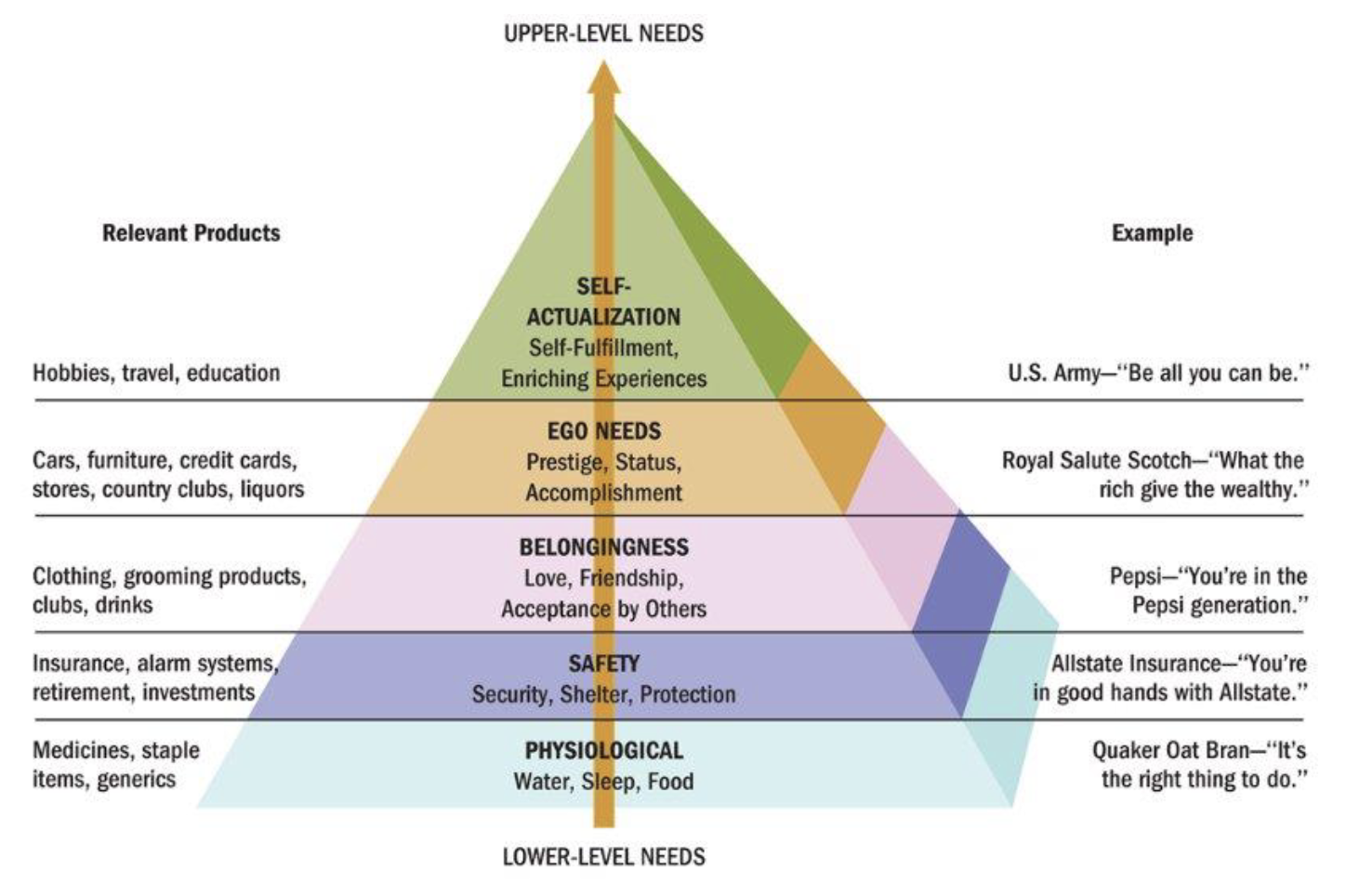
Motivation is the reason for behavior, driven by the state of tension of consumer need. Motivation comes from needs (essentials) and wants (desires), laid out in Maslow’s hierarchy of needs:
Involvement
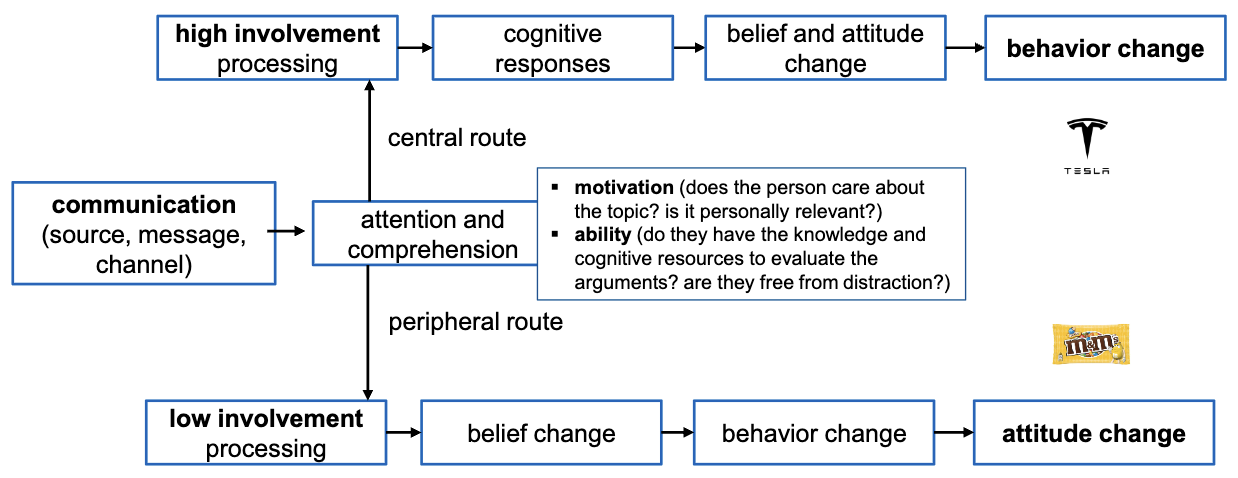
Involvement is a person’s perceived relevance of an object based on their needs, values and interests. It’s the motivation to process information.
It can be increased by customization/DIY steps/co-creation, gamification, prominent stimuli, celebrity endorsers, coming up with novel concepts, or providing value.
When consumer actively process information from a central route of persuasion (ads with strong, convincing arguments and emotional links to higher-order goals), this leads to high involvement, whereas information from a peripheral route (ads with weak arguments but attractive visuals or celebrity endorsements) leads to low involvement.
The Self
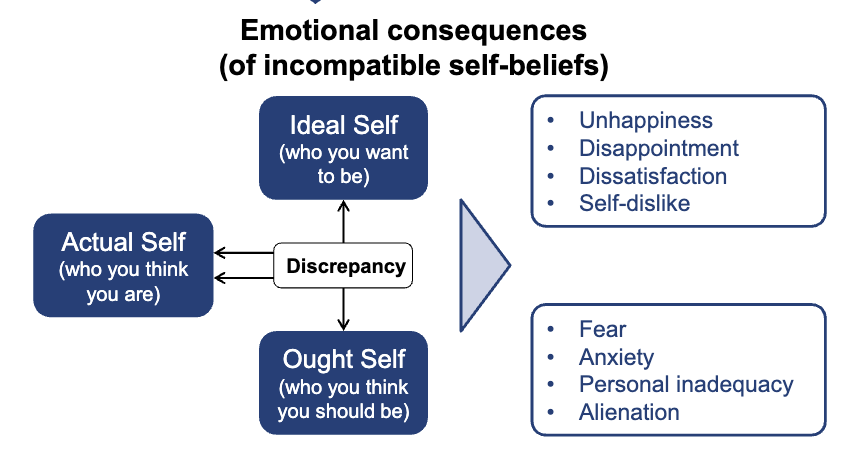
You are what you buy. Consumers create a relationship between self-concept and brand image, thus prefer products that maintain this self-concept. This is also why some people resist automation – it replaces skills that are instrumental to self-signaling an identify (e.g. being able to drive a car for toxic men).
This is relevant for targeting, as targeting strong identifiers for personality involves the risk of damaging these identify-relevant tasks.
Consumer Behavior Research
Consumer behavior is a multi-disciplinary field, ranging from micro-level (experimental psychology) to macro-level (cultural anthropology).
Research Methods
- Qualitative: Focus groups, in-depth interviews, ethnography.
- Quantitative: Surveys, experiments, behavioral analytics.
- Digital Era Methods: Online behavior tracking, social listening, e-commerce patterns, and GenAI “deep research” tools.
Data-Informed Decision Making
To turn data into strategic value, insights must be “good” and part of a structured process.
What makes an insight "good"?
- Actionable: Can be directly applied to business decisions.
- Non-obvious: Provides new or deep understanding beyond surface-level data.
- Grounded: Based on real, observed consumer behavior.
- Linked: Connected to specific business outcomes or decisions.
The “Six A” Framework
Decision-making should start with a question, not the data itself.
- Ask: Formulate a focused question to answer.
- Acquire: Search for the best available data.
- Analyze: Critically appraise and analyze the data.
- Apply: Integrate data into your mental model and decision process.
- Announce: Decide on a course of action and communicate it.
- Assess: Monitor the outcomes to refine future decisions.
Note: While Ask, Acquire, and Analyze build the foundation, the actual business value is created in the Apply, Announce, and Assess stages.
Readings
Readings
- Leung et al. (2018) – Resisting Automation: High identifiers resist automation in identity-relevant tasks because it prevents them from attributing positive outcomes to their own skills (internal attribution), which is central to their identity-based consumption.
- Norton et al. (2012) – The IKEA Effect: Labor increases the valuation of self-made products, but only when the labor results in the successful completion of a task. Unsuccessful or incomplete labor does not increase value.
- Patrick et al. (2017) – Allure of the Hidden: Packaging that requires “unveiling” (removing a cover from a stationary object) enhances perceived value by signaling that the product is protected and pristine, though this effect is neutralized if the product is perceived as contaminated.
- Schroll et al. (2018) – Handwritten Typefaces: Handwritten typefaces humanize products by creating a sense of “human presence,” which increases emotional attachment and product evaluations, particularly for hedonic products and new brands.