Resources
Types of Warehouses
Warehouses can be classified based on their usage and storage strategies:
- Types: Sourcing, transshipment, or sales warehouses.
- Racking Systems: Shelf racks, pallet racks, high-bay racks (high automation/space utilization vs. higher investment).
- Floor Storage: Highly flexible and low investment, but difficult inventory management and low automation.
Storage Strategies
Warehouse storage strategies focus on where to store stock keeping units (SKUs) to optimize space and picking speed. Warehouses have transaction and storage functions, but also serve for safety stocks, balancing material flows, speculating on pricing, or might add value to the process (e.g. cheese).
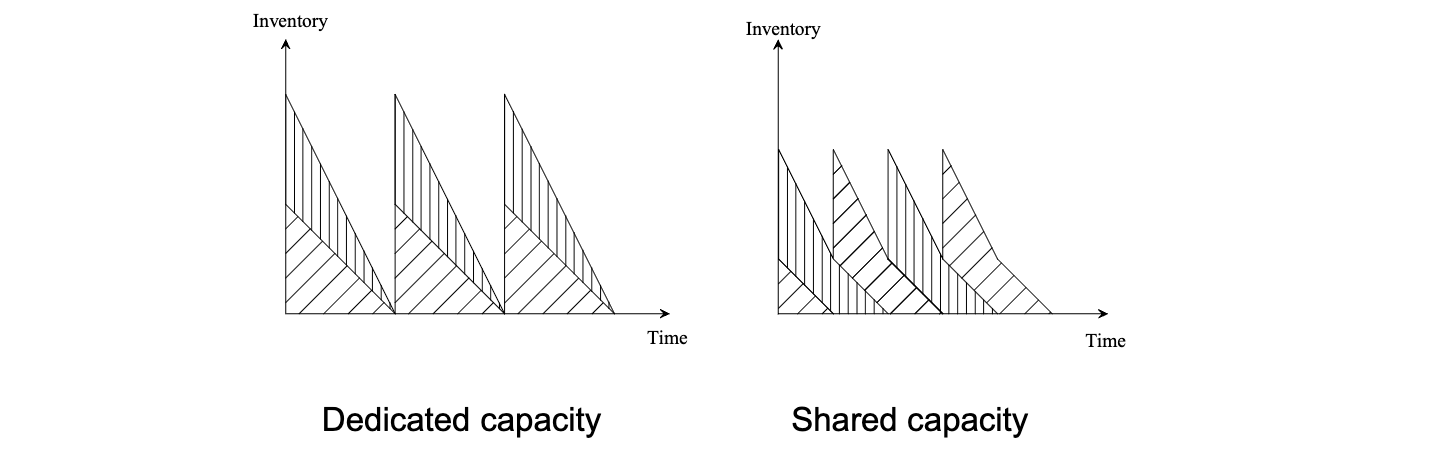
This is relevant as inefficient ordering strategies (e.g. ordering everything at the same time) can lead to higher storage requirements:
Location Strategies
Storage location within a warehouse might be assigned based on different strategies:
- Fixed / Dedicated: Each SKU has a designated spot. Easy for manual pickers, but poor space utilization.
- Shared / Chaotic: Any open slot is used. Maximizes space utilization; requires dynamic tracking. Allocated randomly, or based on closest free location.
- Zone Storage: Categorized by product attributes (e.g., turnover rate, hazardous materials, refrigerated items).
Access Frequency Optimization
To optimize picking efficiency, SKUs can be stored based on their access frequency:
- High-Runner Zone: High-demand items placed near Input/Output (I/O) points to shorten travel time.
- Cube-per-Order Index (COI): . Lower COI items are assigned closer to the I/O point.
Items may be withdrawn under FIFO/LIFO or shortest path regimes.
Assignment Optimization Problem
Allocating products to storage can be seen as an optimization problem:
- products to bins/storage locations
- Access frequency of per product , each bin has a distance to picking start point
- Linear cost factor per distance and quantity unit
- Binary decision variable if is allocated to
Material Flow
Focuses on physical movement, layout, routing, and order processing heuristics.
To retrieve items from the warehouse, two strategies exist based on the level of automation:
- Man-to-Goods: Picker travels through aisles to items. Focuses on route optimization.
- Goods-to-Man: Automated systems (e.g., AS/RS, Carousels) bring items directly to the operator, eliminating travel time.
Picking might happen:
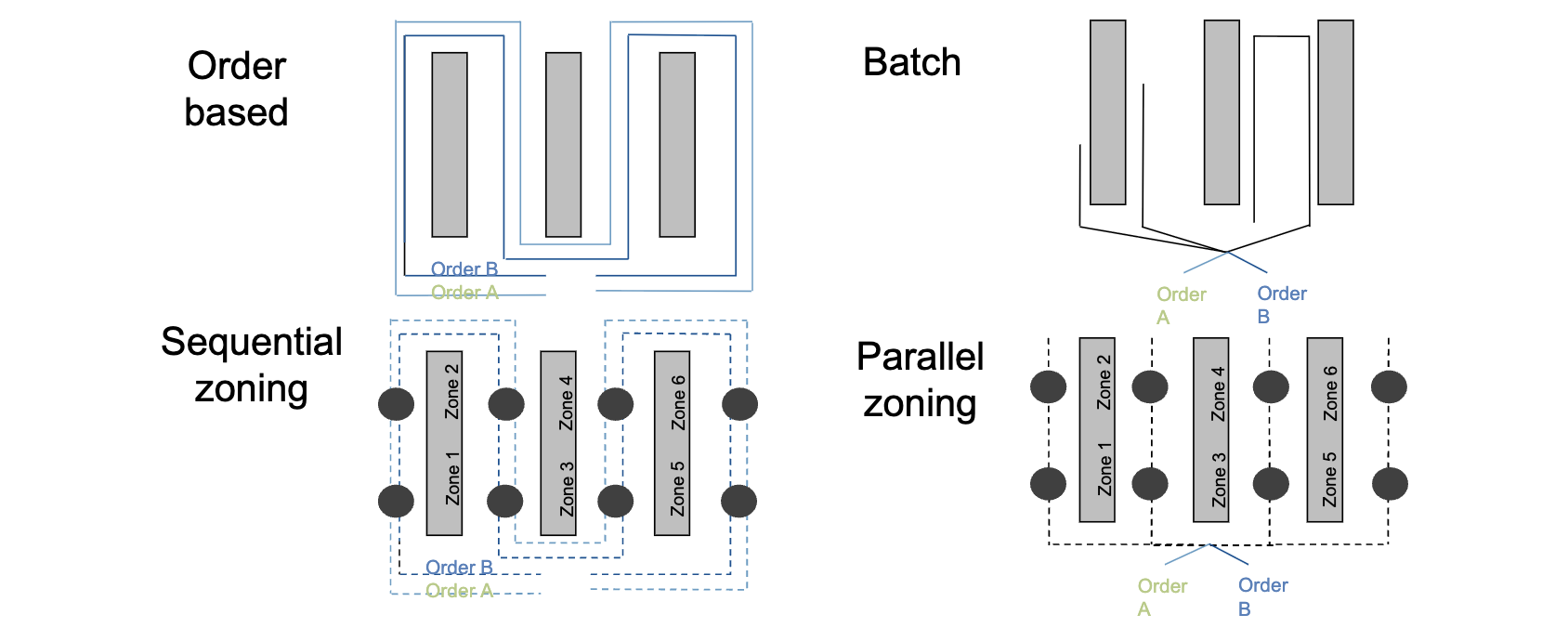
- Order-Based: One picker processes a complete order sequentially (single stage).
- Batch Picking: Multiple orders are picked simultaneously in a single trip, then sorted later (multi-stage).
- Zoning (Parallel or Sequential): Splitting warehouse areas into zones to distribute picking workloads, i.e. parallel (multiple pickers in different zones) or sequential (one picker moves through zones).
Picked items are then put to either a static (fixed and predetermined) or dynamic (based on current order requirements) staging area before shipping.
Picking Sequences
On the basis of the Traveling Salesman Problem, there are common sequences to minimize the distance traveled by pickers (every isle means every aisle with a pick):
- S-Shaped: Completely traverse every aisle containing a pick.
- Returner: Enter an aisle, pick, and reverse out of the same end.
- Center Line: Fully traverse the first and last aisles; enter other aisles only up to the center line.
- Largest Gap: Fully traverse the first and last aisles; in intermediate aisles, turn around at the largest gap between pick locations (where the gap is the distance between two consecutive pick locations or the start/end of the aisle).
Queueing Theory
Queueing theory describes processes and how to distribute them across multiple servers. A process is a sequence of activities with a start, end, and objective. They are divided into core/support/control processes or main/sub/activities.
Queuing theory was not discussed during the lecture (only a brief overview up to slide 316).