Resources
Futures are standardized contracts that obligate the buyer to purchase, and the seller to sell, a specific asset at a predetermined price and date in the future. They are commonly used for hedging risk or for speculative purposes in financial markets.
Futures
A futures contract specifies:
- the underlying asset: commodities, financial instruments, indices, etc.
- contract size, delivery agreements (cash/location) and delivery month
- price quotes and position limits
Daily settlement is realized through margin accounts, in other words, the gains and losses are calculated daily and the margin account is adjusted accordingly. This process is known as “marking to market.”
Futures can be traded:
- Over-the-counter (OTC): Directly between parties, often customized to meet specific needs. Contracts are cleared bilaterally. Also called Forward contracts.
- Exchange-traded: Standardized contracts traded on organized exchanges, providing liquidity and transparency. Here, the CCP (central counterparty) matches buyers and sellers to guarantee the contract and reduce counter-party; contracts are cleared centrally. Also called Futures contracts.
Relevant terms:
- Open Interest: The total number of outstanding futures contracts that have not been settled or closed. It represents the total number of contracts held by market participants at any given time. Open interest is an important indicator of market activity and liquidity.
- Settlement Price: The price at which a futures contract is settled at the end of each trading day. It is used to calculate gains and losses for margin accounts and to determine the daily settlement of futures positions.
- Volume of Trading: Well, the number of trades per day.
Common Futures
- DAX Futures: On the DAX index, tick value is 25€ for each 1 point. Additional details on slide 4.
- BUND Futures: German government bonds with 8.5–10.5 year maturity and a hypothetical coupon of 6%. 100k€ contracts with 0.01% ticks; physical settlement; matures on the 10th calendar day with delivery to the next quarter. Daily settlement price is the volume weighted average of all transactions the minute before 17:15. For payment at delivery, a conversion factor accounts for the difference in the coupon (should be 6%) and maturity (should be 10 years).
Margining
Cash or a marketable security is deposited by investors in a margin account to cover potential losses. Margin accounts are adjusted daily based on the gains or losses of the futures position. Investors have margin accounts with their brokers, whereas brokers (clearing members) have margin accounts with the CCP. There are three types of margins:
- Initial Margin: The amount required to open a futures position, typically a percentage of the contract value.
- Maintenance Margin: The minimum balance that must be maintained in the margin account. If the account falls below this level due to losses, a margin call is issued, requiring the investor to deposit additional funds to bring the account back to the initial margin level.
- Variation Margin: The amount of money that must be added to the margin account to cover losses from daily settlement. It represents the daily gains or losses on the futures position.
Margin calculation is complex, though there are calculators, i.e. for Eurex.
Margin Call
A margin call occurs when the balance in a margin account falls below the maintenance margin level set by the CCP. The investor must deposit additional funds to bring the account back to the initial margin level. Failure to meet a margin call can result in the liquidation of the investor’s position by the broker to cover losses.
Delivery
Usually, companies trading futures close their positions before the delivery date to avoid the physical delivery of the underlying asset. If a position is still open at the delivery date, the contract is settled either through physical delivery of the underlying asset or through cash settlement, depending on the terms of the contract. Futures that have been held for hedging purposes and are being sold then become available once again on the spot market.
Term Structure
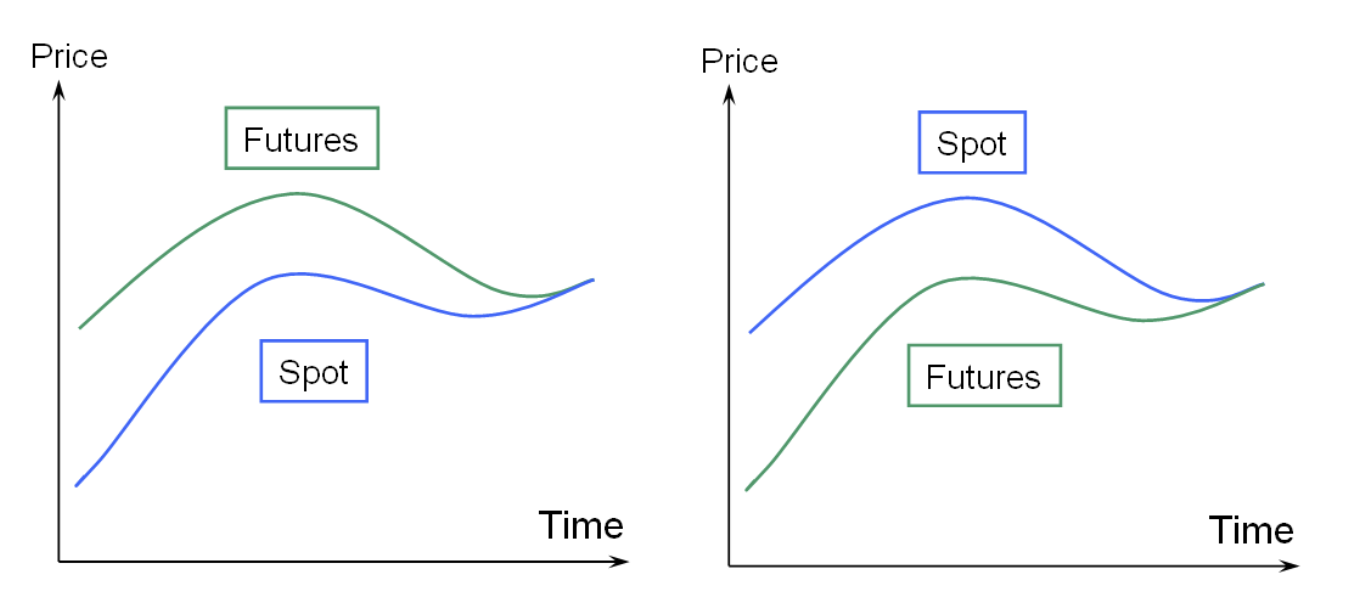
Futures prices can increase or decrease in price with maturity.
- Contango: Prices increase for contracts with longer maturity. This can occur when the cost of carrying the underlying asset (storage, insurance, financing) is positive, or when market participants expect future prices to rise.
- Backwardation: Prices decrease for contracts with longer maturity. This can occur when the cost of carrying the underlying asset is negative, or when market participants expect future prices to fall.
Hedging
A hedge is an investment specifically to reduce or cancel out the risk in another investment: typically price, exchange rates, or interest rate fluctuations. Perfect hedges (eliminating the entire risk) are hard to realize. Natural hedges are investments that reduce undesired risk by matching cash flows.
- Long Hedge: A long position in a future contract, e.g. to fix the price of buying a future asset.
- Short Hedge: A short position in a future contract, e.g. to fix the price of selling a future asset.
- Another option is hedging with Options
Hedging enables companies to focus on their main business, stabilizes cash flows and external risks, and therefore allows them to commit on long-term investment projects. However, hedging is expensive, explaining losses on hedges can be difficult, and shareholders are usually well diversified themselves.
The profit or loss of a hedge is determined by the difference between the spot price of the underlying asset at maturity () and the futures price at maturity (), adjusted for the initial futures price (). The formula for calculating the profit or loss of a hedge is (see basis below):
Basis Risk
The basis is the difference between the spot price of the underlying asset and the futures price of the contract. Basis risk arises when the hedge does not perfectly offset the risk of the underlying asset due to changes in the basis over time.
If the contract is closed before maturity, the basis risk is the difference between the spot price of the underlying asset and the futures price at the time of closing. If the contract is held to maturity, basis risk is eliminated, as the futures price converges to the spot price at expiration ( at maturity).
The implication of this basis risk is that long-term hedges are not effective, as the basis can change significantly over time. Therefore, hedges are usually closed just before maturity to minimize basis risk.
Pricing of Futures
These pricing models assume a frictionless market with no transaction costs, same tax rates on all net trading profits, borrowing and lending at same risk-free rates and arbitrage-using investors.
Carry-Arbritrage Pricing
To find a fair price for futures, carry-arbitrage pricing constructs a riskless, zero-investment portfolio at with a future short to sell the underlying asset at time for price ; an index long to buy the underlying asset for its spot price ; and a loan of at the continuously compounded risk-free rate .
At maturity, the portfolio is closed by fulfilling the future short for and repaying the loan for . Therefore, to ensure no free lunch, the arbitrage-free future price is:
If is larger, the future is overpriced and there would be riskless profit — an arbitrage opportunity.