Resources
Supply Chain Logistics
Supply Chain Management is the coordination of integrated business activities across suppliers, manufacturers, warehouses, and stores to produce and distribute goods at the right quantity, location, and time while minimizing costs and meeting service levels.
Management instruments include cooperations (alliances/networks), central/decentral integration, standardization (modularization, postponement), customer-oriented contacts, and system optimization.
- Internal Supply Chain: Procurement Production Distribution Disposal.
- External Supply Chain: Integration of suppliers and customers.
- Key Flows: Information, material, and payments.
Supply Chain Structures
Several topologies exist for supply chain structures, including:
- Serial: Direct Supplier-Purchaser relationships.
- Convergent: Assembly-driven systems, e.g. printer production with intermediate part assemblies.
- Divergent: Distribution-driven systems, e.g. multi-stage warehousing and retail store networks.
- General Networks: Interconnected combination of assembly and distribution aspects.
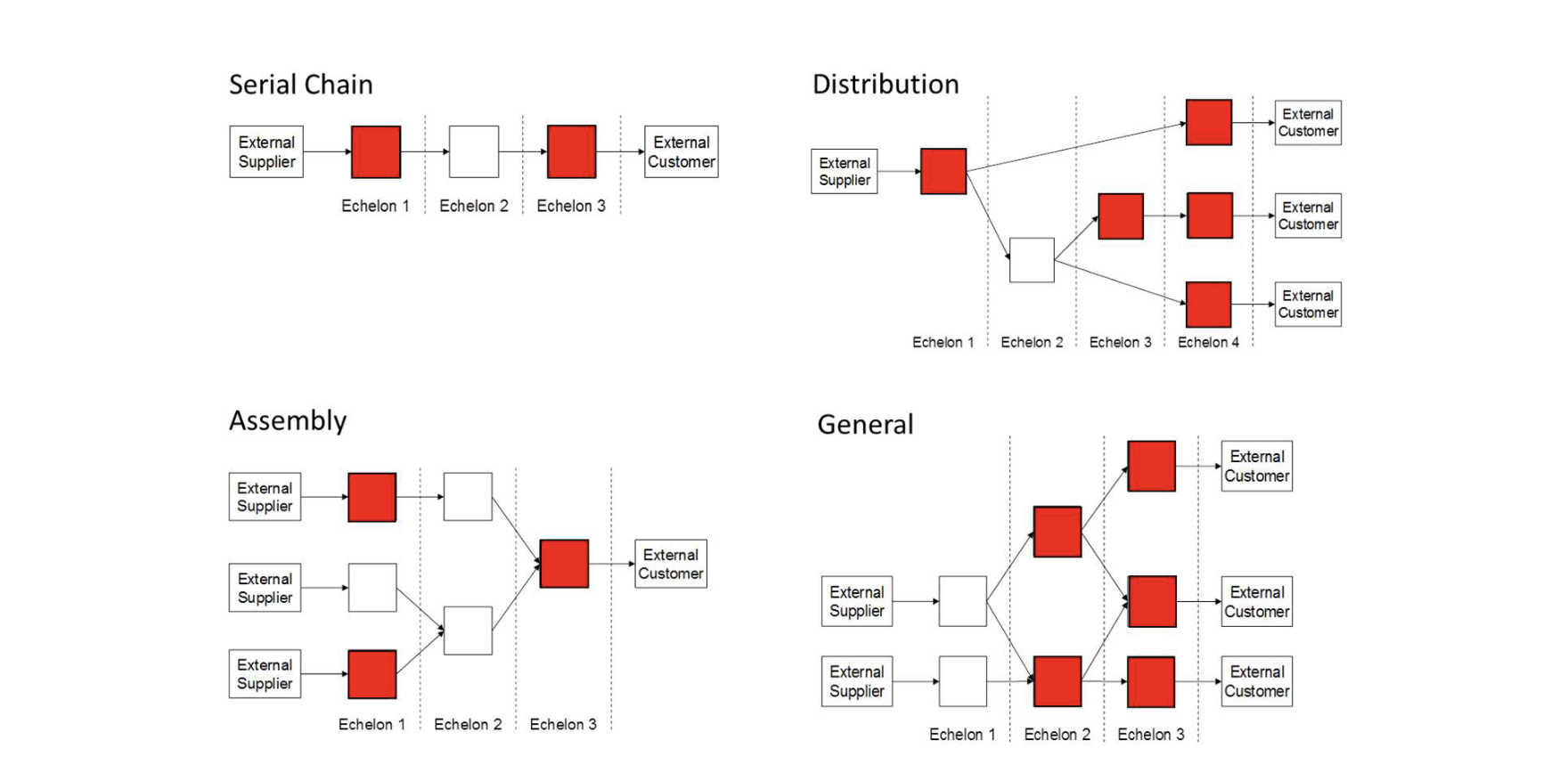
Additionally, reverse logistics is a critical component of supply chain management, focusing on the flow of goods from consumption back to origin for value recapture or proper disposal:
- Reverse Logistics: Flow of goods from consumption back to origin to recapture value or manage proper disposal (commercial returns, warranties, EOL).
- Closed-Loop SCM: Integrated simultaneous management of forward and reverse flows over the full product life cycle. This includes the 10 Rs of sustainability, from refuse, reduce, reuse down to recycle, recover, re-mine. Also see Leonhard Teichert @ Circular Republic.
- The R-Ladder Framework: Strategies ranging from narrowing the loop (Refuse, Reduce, Resell) to slowing the loop (Repair, Refurbish, Remanufacture) and closing the loop (Recycle, Energy Recovery).
Supply chain planning is further discussed in Master Production Scheduling.
Planning Frameworks
- Strategic (3+ years): Network design, facility locations, long-term SC objectives, make-or-buy decisions.
- Tactical / Functional (months to years): Customer allocation, inventory deployment, safety stock positioning, vendor selection.
- Operational (minutes to months) Day-to-day transportation routing, scheduling, and short-term inventory management.
Fisher’s Strategic Fit Framework
Functional Products
Functional products have predictable demand, long life cycles (2+ years), and low margins (5-20%). There are typically few product variations, low margin of forecast error, a low stockout rate, no end-of-season sales, and a long lead time. An example is basic household goods.
These products require a Physically Efficient supply chain to minimize costs and maximize capacity utilization.
Innovative Products
Innovative products have unpredictable demand, short life cycles, and high margins. They often have millions of product variations, 40100% of forecast error, stockout rates of 1040%, end-of-season sales (10~25%), and a short lead time (1 day to 2 weeks). An example is fashion apparel.
These products require a Market Responsive supply chain to maximize responsiveness and flexibility.
Efficient vs Responsive Supply Chains
| Physically efficient process | Market-responsive process | |
|---|---|---|
| Primary purpose | Supply predictable demand at lowest cost | Respond quickly to unpredictable demand |
| Manufacturing focus | Maintain high utilization rates | Deploy excess buffer capacity |
| Inventory strategy | Maximize turns and minimize inventory | Hold buffer stocks (parts or finished goods) |
| Lead-time focus | Shorten lead time without increasing cost | Invest aggressively to minimize lead time |
| Supplier selection | Choose for cost and quality | Choose for speed, flexibility, and quality |
| Product design | Maximize performance and minimize cost | Use modular design to delay differentiation |
Supply Chain Processes
SCOR Model
An ideal-typical, cross-sector reference model used to standardize process descriptions, visualize supply chain flows, benchmark against best practices, and establish KPIs.
5 Core Management Processes:
- Plan: Resource/network planning, balancing aggregate demand and supply.
- Source: Supplier selection, contracting, and ordering raw materials.
- Make: Production scheduling and execution across process types (Make-to-Stock, Make-to-Order, Engineer-to-Order).
- Deliver: Order management, distribution, logistics, and customer fulfillment.
- Return: Managing return flows of products/materials for repair, remanufacturing, recycling, or disposal (Reverse Logistics).
4-Level Hierarchical Structure:
- Top-Level: Definition of scope and core process types.
- Configuration Level: Process categories (e.g., discrete vs. continuous operations).
- Process Element Level: Detailed input/output definition, performance metrics (cycle time, capital commitment, service levels), and best practices.
- Implementation Level: Company-specific execution and IT workflows.
Dynamics
Bullwhip Effect
The amplification of demand variability as one moves upstream in the supply chain, leading to inefficiencies such as excess inventory, stockouts, and increased costs. It can be caused by demand forecast inaccuracies, delivery time, imperfect lot sizing, fluctuating prices, or anticipation of shortages. Mitigation strategies include information sharing, order smoothing, and lead time reduction.