Resources
Procurement and Sourcing
Procurement is the process of acquiring goods and services from external suppliers, while sourcing involves identifying, evaluating, and selecting suppliers to meet the organization’s needs.
Strategic Sourcing: Make or Buy
The decision of how much value should be added in-house vs. sourced externally (in-house value added processes vs total required value added).
Vertical integration can be forward (towards the customer, by owning distribution channels) or backward (towards the supplier, by owning suppliers).
When innovating, a company is likely to vertically integrate (insource), whereas outsourcing is likely when concentrating on core competencies. A hybrid strategy may be chosen
Outsourcing
Outsourcing reduces costs, allows companies to focus on core competencies (lean processes), enables access to key technologies and has low capital requirements.
However, it also brings a risk of dependence on the supplier, agency problems (hold ups due to renegotiations and the moral hazard of opportunistic behavior), and loss of flexibility.
In general, the choice of level of integration depends on 4 major factors, where a higher value indicates a need for insourcing:
- Specificity: Design, Know-How, Logistics (high specificity → insource)
- Strategic Importance: Core competencies, critical processes (high strategic importance → insource)
- Uncertainty: Demand, Technology (high uncertainty → insource)
- Frequency: Volume, Repetition (high frequency → insource)
The Outsourcing Matrix
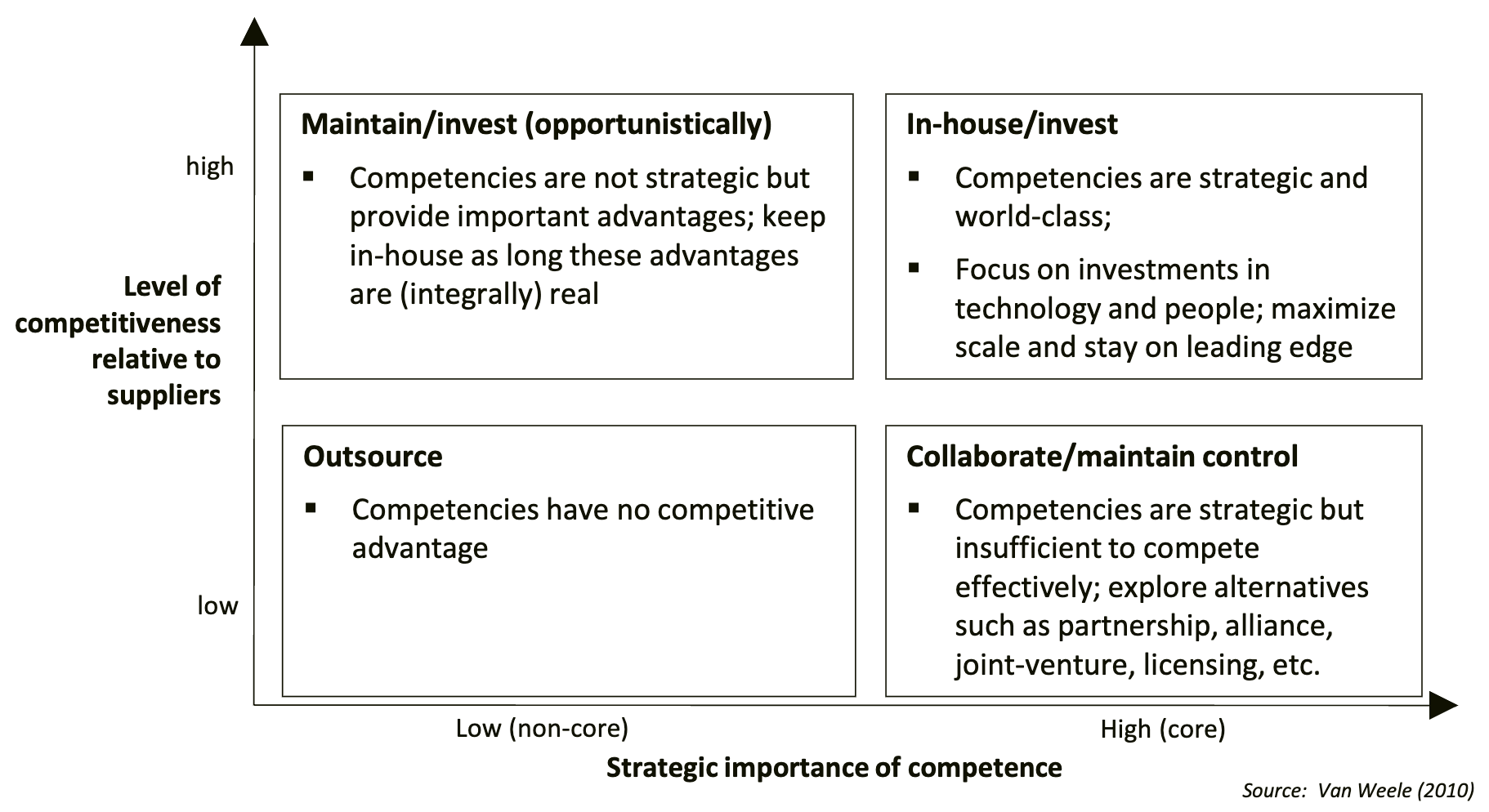
If a company has a high level of competence in a strategically relevant area, it should insource (make), or outsource in the opposite case. For less relevant sectors where the company has high competence, it should invest in the opportunity. In relevant areas with little competence, the company should collaborate with suppliers while maintaining control.
TCE Framework
The Transaction Cost Economics framework evaluates the costs of transactions and the governance structures that minimize these costs. It helps determine whether to insource (Hierarchy → Controlling own production) or outsource (Market → Buy from externals) based on the hidden costs of buying from market:
- Search & Information Cost: Finding suppliers, evaluating capabilities, and vetting reliability before doing business.
- Bargaining Costs: Negotiating prices, drafting contracts, and aligning on legal terms.
- Enforcement Costs: Auditing quality, tracking delivery deadlines, and policing supplier compliance.
- Adjustment Costs: Modifying contracts, re-negotiating terms, or fixing scope drift during the runtime.
Qualitative Break-Even Analysis
This method is used to mathematically choose between Make with fixed costs and variable costs , and Buy with fixed costs and variable costs .
In-House production is chosen if one of:
- dominates unconditionally: If and
- but : Produce in-house () only if quantity exceeds the break-even threshold:
- The other way arund, but : Outsource () only if exceeds the break-even threshold.
Sustainable Sourcing
- Green Supply Chain Management (GrSCM): Integrates environmental considerations across product design, material sourcing, manufacturing, logistics, and reverse logistics (recycling, remanufacturing, disposal).
- Supplier CSR & Governance: Modern outsourcing exposes firms to reputational hazards (e.g., labor violations, environmental destruction at supplier sites).
- Regulatory Landscape: Mandatory due diligence laws force companies to audit Tier-1 and deeper suppliers (e.g., Germany’s Lieferkettensorgfaltspflichtengesetz, UK Modern Slavery Act, and EU CSDDD).
Supply Cost Dynamic: Learning Curve
The Learning Curve is an observation that each time the cumulative production volume doubles, inflation-adjusted unit production costs decrease by a constant percentage rate (typically 10–30%) due to experience, process optimization, and efficiency gains. Also see Achieving Cost Advanatges.
The number of doublings from to is . Plugging in the unit cost function yields the power-law learning function:
Supplier Evaluation
Procurement Market Research aims to improve market transparency, discover substitute goods, and evaluate supplier capability/pricing structures. The core tradeoffs are
- Supplier Relationship: Short-Term for aggressive price-bidding or Long-Term for collaborative R&D and stability.
- Number of Suppliers: Single to maximize volume discounts or Multiple to diversify operational risk and maintain price pressure.
- Geography: Local for shorter lead times, fewer emissions, easer audits or Global for lower cost.
Resilience
Resilience can reduce disruption impact and recovery time, which is why supply chain managers often evaluate suppliers based on their resilience capabilities, including redundancy, flexibility, and responsiveness.
Kraljic Portfolio Matrix
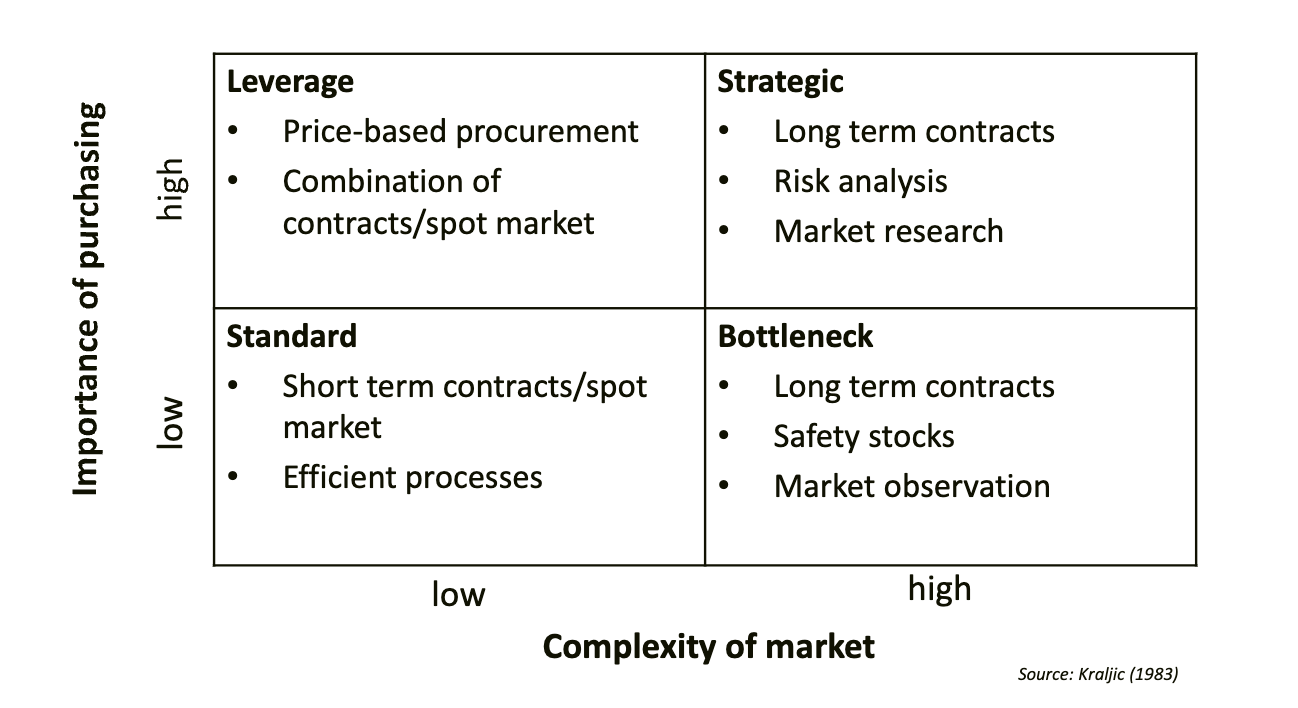
The Kraljic Portfolio Matrix is a strategic tool for supplier segmentation based on supply risk and profit impact. It categorizes suppliers into four quadrants:
- Standard: Short-term contracts, efficient processes.
- Leverage: Price competition, spot/contract mix.
- Bottleneck: Long-term contracts, safety stocks.
- Strategic: Long-term partnerships, joint risk analysis.
Lead Time in Dual Sourcing
Splitting an order between two independent suppliers reduces effective lead time , sharply dropping tail-risk delays.
Suppliers are commonly evaluated based on:
- Quality: Reputation, certifications, packaging
- Conditions: Price, discounts, payment arrangements
- Service: Lead time, reliability, efficiency, capacity, flexibility, value added services
Scoring Method
A simple multi-criteria decision model mapping performance across criteria () using weights (totaling 1, ) and scaled fulfillment scores :
where is the overall score for supplier . The supplier with the highest score is preferred.
However, subjective weight selection and scoring scales make it vulnerable to bias and manipulation.
Data Development Analysis
DEA is a non-parametric linear programming tool used to measure relative efficiency among Decision Making Units (DMUs) (suppliers) with multiple inputs and outputs.
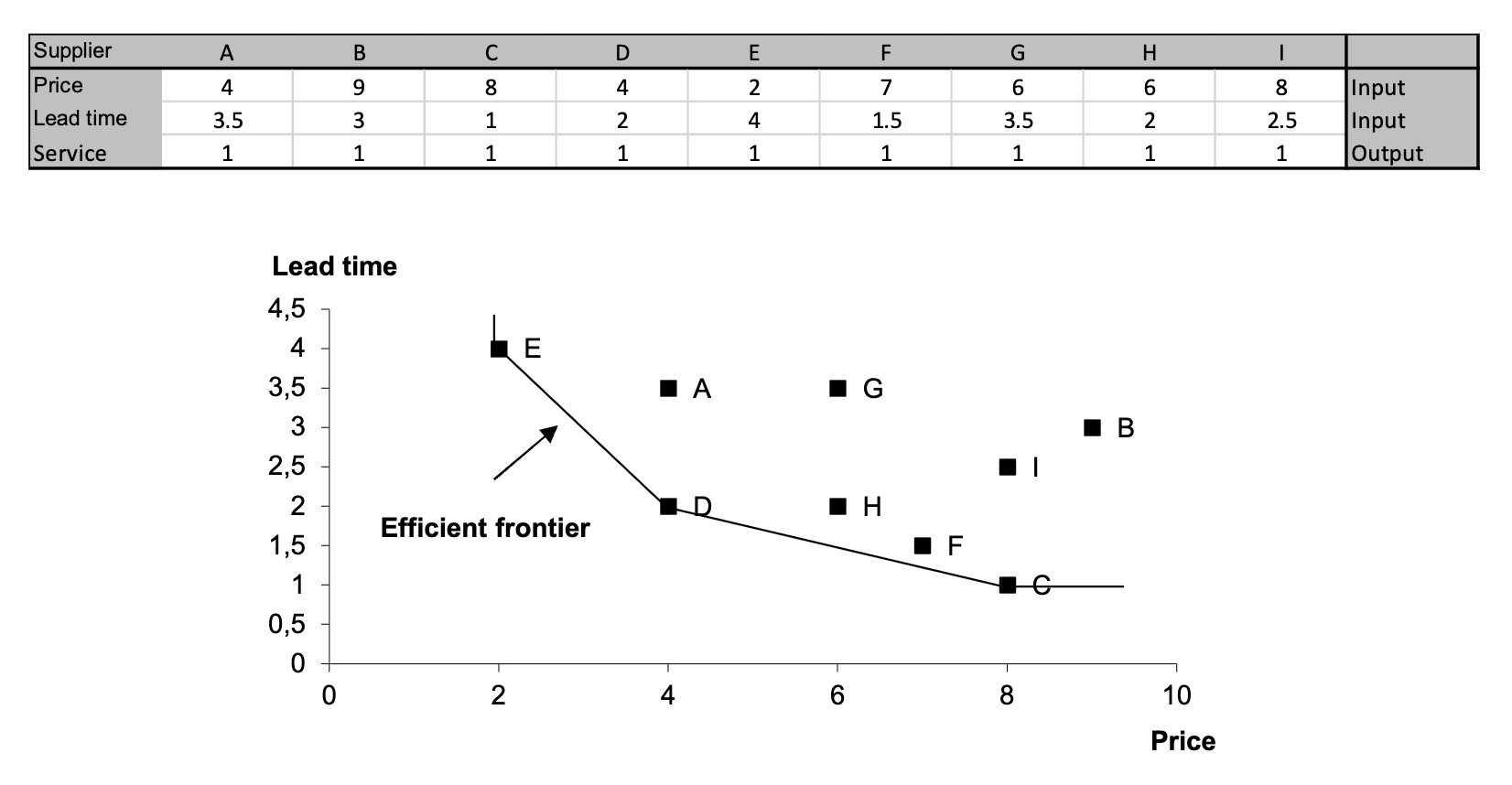
The Efficient Frontier represents the set of suppliers that are most efficient (score = 1). Suppliers below the frontier (score < 1) are inefficient and can be improved by either reducing inputs or increasing outputs.
Risk Sharing in Contract Design
In addition to the decision on short-term and long-term contracts (see above), retailers and suppliers can design contracts that share the risks of uncertain demand and supply conditions:
- Buy-back contracts: Supplier repurchases unsold stock at a discount.
- Revenue sharing: Lower wholesale price in exchange for a percentage of sales revenue.
- Quantity flexibility: Order adjustments allowed after observing early demand signals.