Resources
Packaging
Packaging provides product functions (providing quantity), marketing functions (advertising and information), usage functions (additional purposes for the customer), and logistics functions (protection, transport, and storage, manipulation, information).
Tasks for packaging include design (volume, weight, bulkiness, fragility, legal conditions, material), the process (automated packaging) and closed-loop logistics (returnable packaging, disposal).
Packaging is divided into multiple levels:
- Good: The smallest unit. Loose goods, fluids, mass products
- Article: Sales unit. Packaged goods, bags, cans.
- Outer Packaging: Packaging unit. Delivery orders, pallets, boxes.
- Delivery: Transport unit. Pallets, parcels, containers.
- Load: Loading unit; freight.
- Transport: Transport unit. Truck, ship, wagon.
Stowage Planning
The process of optimally arranging cargo in a transport unit (e.g., container, truck, ship) to maximize space utilization, ensure safety, and facilitate efficient standardized loading and unloading. It involves considering weight distribution, fragility of goods, and accessibility for delivery.
Resource Allocation
Knapsack Problem
The knapsack problem is a combinatorial optimization problem where the goal is to maximize the total value of items placed in a bag without exceeding its weight capacity. items have a value and capacity requirement , with a limited capacity of . The boolean decision variable indicates whether item is included in the knapsack.
Knapsack Model
Decision variables:
- Selection state: if object is chosen, otherwise
Objective:
- Maximize total value:
Constraints:
- Resource capacity:
Bounds:
- Binary restriction:
Greedy Approach
To solve the knapsack problem, simply determine a priority for each possible item () and select items in descending order of priority until the capacity limit is reached. This greedy approach works well for the fractional knapsack problem, where items can be divided, but may not yield an optimal solution for the 0-1 knapsack problem.
Packing
Cutting Stock Problem
The goal is to cut large stock materials (like rolls of paper, metal sheets, or fabric) into smaller pieces to meet specific demand sizes while minimizing waste. For example, from a 210cm roll, supply 200 45cm rolls and 3000 27cm rolls; with a maximum storage for overproduction of 160 cut rolls.
Data: Order data, specification of cutting patterns, storage capacity.
Decision: Cutting pattern and respective quantities.
Objective: Minimize waste or overproduction.
Constraint: Fulfill orders, compliant with technology, storage capacity.Cutting Stock Model
Decision variables:
- Number of rolls cut according to pattern
- Rest and of the two orders (overproduction)
Objectives:
- Minimize waste:
- Minimize used rolls:
Constraints:
- Order fulfillment 1:
- Order fulfillment 2:
- Storage restriction:
Bounds:
- Non-negativity:
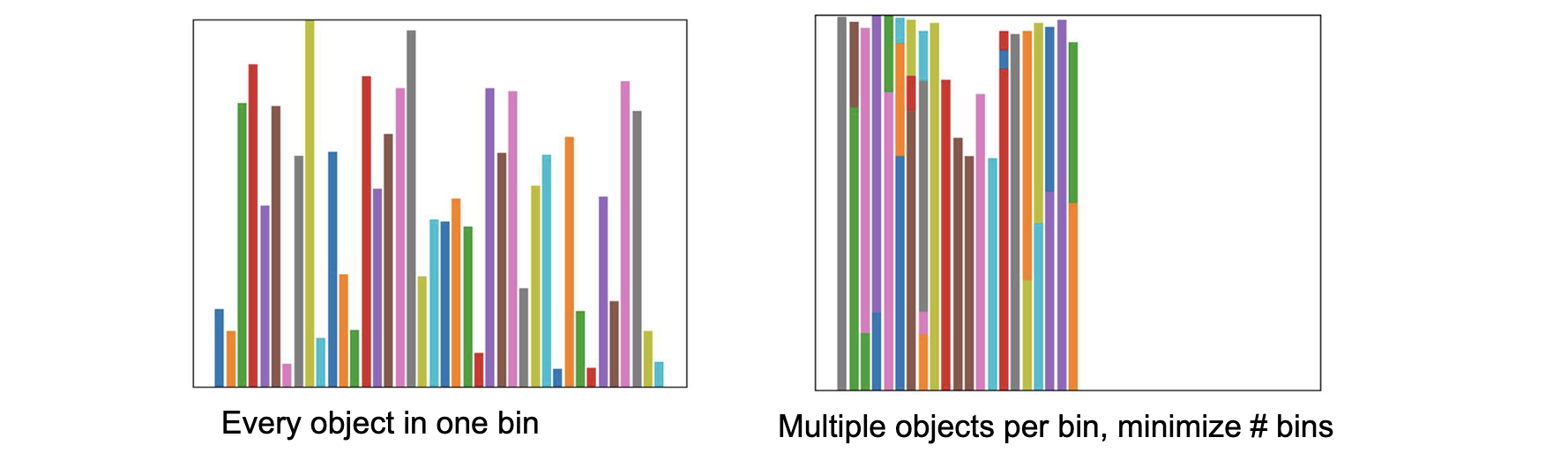
Bin Packaging Problem
An optimization problem where the goal is to items into the least number of bins, respecting allocation and capacity constraints. Each item has a size , and each bin has a capacity . The boolean decision variable indicates whether item is in bin , and indicates whether bin is used.
Bin Packing Model
Decision variables:
- Bin usage: if bin is used, otherwise
- Item allocation: if object is allocated to container , otherwise
Objective:
- Minimize required bins:
Constraints:
- Bin capacity:
- Allocation of all objects:
Bounds:
- Binary variables:
3D Bin Packing Problem
An extension of the bin packing problem where items and bins are three-dimensional. Each item has dimensions , and each bin has dimensions .
Priority Rules
Priority rules are simple heuristics that assign a priority to each item or task based on specific attributes, such as size, weight, or value. These rules help in making quick decisions for packing or scheduling problems without the need for complex optimization algorithms.
Presorting objects can drastically improve the performance of these heuristics.
- First Fit Heuristic: For bin packaging, assigns objects to the first bin that has sufficient capacity, or a new one if none are available.
- Best Fit Heuristic: Assigns objects to the bin that will have the least remaining capacity after placement, or a new one if none are available.
Block Heuristics: Layer Plans
A class of geometric algorithms used to design optimal two-dimensional layouts (layer plans) for placing identical items onto a standardized packing space, such as a Euro-pallet. It focuses on maximizing the number of items on a single layer by arranging them into orthogonal blocks with different orientations.
To find the optimal layer plan:
- Define Block Orientations: Partition the layout area into a set of distinct blocks (often a 3-block division). Items within each individual block share the same orientation (either vertical or horizontal).
- Generate Efficient Partitions: Determine mathematically feasible combinations of item counts along the length and width for each side of the pallet. A partition is considered efficient when the remaining space is too small to fit another item.
- Combine and Validate Plans: Combine the side partitions to form all variations of complete layer plans. Ensure the layout is valid by verifying that adjacent blocks share matching boundary lengths at their intersection points.
- Evaluate Efficiency: Calculate the total number of items () for each permitted combination and select the layer plan that maximizes space utilization.