References without law book default to BGB.
Statutory Law Analysis
This note provides a comprehensive index, systemic mapping, and visual flowcharts for all statutory law sections mentioned in the Introduction to Business Law curriculum. It is structured specifically for review in Obsidian and optimized for exam preparation.
Legal Framework & Course Topics
This map outlines the structural divisions of private law (BGB books, HGB, and special acts) and how they organize the specific topics covered throughout the course.

Mermaid Code
flowchart TD


    ROOT([Private Law]) --> BGB[Civil Law: BGB]
    ROOT --> HGB[Commercial Law: HGB]
    ROOT --> SPEC[Special Public & Civil Acts]

     BGB Book 1 Topics
    BGB1 --> BGB1_T1[Contract Formation<br>§§ 145-147]
    BGB1 --> BGB1_T2[Capacity & Minors<br>§§ 104-112]
    BGB1 --> BGB1_T3[Validity & Defects<br>§§ 119-124, 134, 138]
    BGB1 --> BGB1_T4[Agency & Representation<br>§§ 164-179]
    BGB1 --> BGB1_T5[AGB Incorporation & Form<br>§§ 125-128, 305]

     BGB Book 2 Gen Topics
    BGB2_GEN --> BGB2_GEN_T1[Breach of Duty & Damages<br>§§ 280-286]
    BGB2_GEN --> BGB2_GEN_T2[Impossibility<br>§ 275]
    BGB2_GEN --> BGB2_GEN_T3[Consumer Withdrawal<br>§§ 312b/c, 312g, 355]
    BGB2_GEN --> BGB2_GEN_T4[AGB Content Control<br>§§ 307-309]

     BGB Book 2 Statutory Topics
    BGB2_STAT --> BGB2_STAT_T1[Tort Law<br>§§ 823, 831, 832]
    BGB2_STAT --> BGB2_STAT_T2[Unjust Enrichment<br>§§ 812, 816]

     HGB Topics
    HGB --> HGB_T1[Merchant Status<br>§§ 1-6 HGB]
    HGB --> HGB_T2[oHG & KG Representation<br>§§ 105, 124, 161 HGB]
    HGB --> HGB_T3[B2B Defect Notification<br>§ 377 HGB]
    HGB --> HGB_T4[Prokura / Agency<br>§§ 48-53 HGB]

     Styling
    classDef roots fill:#f4f4f5,stroke:#a1a1aa,stroke-width:2px,color:#27272a,font-weight:bold;
    classDef division fill:#e0f2fe,stroke:#7dd3fc,stroke-width:2px,color:#0369a1,font-weight:bold;
    classDef subDivision fill:#f0f9ff,stroke:#bae6fd,stroke-width:2px,color:#0284c7;
    classDef topic fill:#fef3c7,stroke:#fcd34d,stroke-width:1px,color:#78350f;
    classDef special fill:#f3e8ff,stroke:#e9d5ff,stroke-width:1px,color:#6b21a8;

    class ROOT roots;
    class BGB,HGB division;
    class BGB1,BGB2,BGB3,BGB2_GEN,BGB2_SPEC,BGB2_STAT subDivision;
    class BGB1_T1,BGB1_T2,BGB1_T3,BGB1_T4,BGB1_T5,BGB2_GEN_T1,BGB2_GEN_T2,BGB2_GEN_T3,BGB2_GEN_T4,BGB2_SPEC_T1,BGB2_SPEC_T2,BGB2_SPEC_T3,BGB2_SPEC_T4,BGB2_SPEC_T5,BGB2_SPEC_T6,BGB2_STAT_T1,BGB2_STAT_T2,BGB3_T1,BGB3_T2,BGB3_T3,HGB_T1,HGB_T2,HGB_T3,HGB_T4 topic;
    class SPEC,SPEC_T1,SPEC_T2,SPEC_T3 special;
1. Statutory Index
German Civil Code (BGB) — Book 1: General Part
Governs capacity, declarations of intent (DOIs), contract formation, agency, and validity. (⭐ denotes core/highly relevant exam sections)
| Section | Headline / Brief Description | Mentioned In |
|---|---|---|
| § 13 | Definition of a Consumer (Verbraucher) | Standard Terms & Consumer Protection |
| § 14 | Definition of a Trader / Entrepreneur (Unternehmer) | Standard Terms & Consumer Protection |
| § 104 | Incapacity to contract (Geschäftsunfähigkeit) | Contract Validity & Defects |
| § 105 | Voidness of declaration of intent by incapacitated persons | Contract Validity & Defects, Business Law Algorithms |
| § 105a | Everyday transactions (exception for mentally incapacitated adults) | Contract Validity & Defects |
| ⭐ § 106 | Limited capacity to contract of minors (ages 7 to 17) | Contract Validity & Defects |
| § 107 | Consent of legal representative (for legally disadvantageous transactions) | Contract Validity & Defects |
| § 110 | Performance with minor’s own means (the “pocket money” paragraph) | Contract Validity & Defects |
| § 112 | Independent operation of a business by a minor | Contract Validity & Defects |
| ⭐ § 119 | Avoidance for mistake (declaration, transmission, or characteristics) | Contract Validity & Defects, Business Law Algorithms |
| § 120 | Avoidance for incorrect transmission by a messenger or agency | Contract Validity & Defects |
| § 121 | Period for avoidance of mistake (without undue delay / unverzüglich) | Contract Validity & Defects, Business Law Algorithms |
| § 122 | Compensation for damage caused by avoidance (reliance/negative interest) | Contract Validity & Defects, Business Law Algorithms |
| ⭐ § 123 | Avoidance for deceit or duress (fraudulent deception or unlawful threat) | Contract Validity & Defects, Business Law Algorithms |
| § 124 | Period for avoidance of deceit or duress (1 year from discovery) | Contract Validity & Defects, Business Law Algorithms |
| § 125 | Voidness due to defect of form (breach of statutory or contractual form) | Business Law Algorithms |
| § 126 | Written form (Schriftform — physical signature) | Contract Formation & Representation |
| § 126a | Electronic form (qualified electronic signature) | Contract Formation & Representation |
| § 126b | Text form (Textform — readable declaration on a durable medium) | Contract Formation & Representation |
| § 128 | Notarial recording (formal certification by a notary) | Contract Formation & Representation |
| § 130 | Effectiveness of DOI to absent parties upon receipt (Zugang) | Contract Formation & Representation |
| § 133 | Interpretation of a DOI (seeking the true, subjective intent) | Contract Formation & Representation |
| § 134 | Statutory prohibition (legal transactions violating statutory bans are void) | Contract Validity & Defects |
| ⭐ § 138 | Immoral transaction; usury/extortion (Sittenwidrigkeit and Wucher) | Law Introduction, Contract Validity & Defects |
| ⭐ § 142 | Effect of avoidance (retroactive voidness from the beginning — ex tunc) | Contract Validity & Defects, Business Law Algorithms |
| § 143 | Declaration of avoidance (notifying the contractual partner) | Business Law Algorithms |
| § 145 | Binding effect of an offer | Contract Formation & Representation, Business Law Algorithms |
| §§ 145–147 | Offer, acceptance, and time limit for acceptance | Business Law Algorithms |
| § 157 | Interpretation of contracts (interpreting according to good faith and custom) | Contract Formation & Representation |
| ⭐ § 164 | Effects of declarations made by representatives (agency requirements) | Contract Formation & Representation, Business Law Algorithms |
| § 165 | Representative with limited capacity to contract (minors as agents) | Contract Formation & Representation |
| § 167 | Granting of authority (Vollmachtserteilung) | Business Law Algorithms |
| ⭐ § 177 | Contract concluded by representative without authority | Contract Formation & Representation, Business Law Algorithms |
| ⭐ § 179 | Liability of representative without authority | Business Law Algorithms |
| § 184 (1) | Retroactive effect of approval / ratification (Rückwirkung der Genehmigung) | Business Law Algorithms |
| § 195 | Standard limitation period (regular prescription period of 3 years) | Business Law Algorithms |
| § 214 | Right to refuse performance due to limitation (Einrede der Verjährung) | Business Law Algorithms |
| § 228 | Defensive necessity (Notstand — damage to threatening thing not unlawful) | Tort Law |
German Civil Code (BGB) — Book 2: Law of Obligations (General Part)
Governs breaches of contract, liability, calculation of damages, AGB control, and consumer protection. (⭐ denotes core/highly relevant exam sections)
| Section | Headline / Brief Description | Mentioned In |
|---|---|---|
| § 241 II | Duties arising from an obligation (duty to respect rights/interests) | Breach of Duty, Business Law Algorithms |
| § 242 | Obligation to perform according to good faith (Treu und Glauben) | Law Introduction, Business Law Algorithms |
| § 249 | Nature and extent of damages (restoration in kind / Naturalrestitution) | Breach of Duty, Business Law Algorithms, Tort Law |
| § 251 | Damages in money (monetary compensation if restoration impossible/disproportionate) | Breach of Duty, Business Law Algorithms |
| § 252 | Lost profits (recoverable as financial damages) | Breach of Duty, Business Law Algorithms |
| § 253 | Compensation for non-material/intangible damage (e.g., pain & suffering) | Breach of Duty, Business Law Algorithms |
| § 254 | Contributory negligence (Mitverschulden — proportional damage reduction) | Breach of Duty, Business Law Algorithms |
| § 273 | Right of retention (Zurückbehaltungsrecht) | Business Law Algorithms |
| ⭐ § 275 | Exclusion of duty to perform (impossibility of performance) | Breach of Duty, Sale of Goods, Business Law Algorithms |
| § 276 | Responsibility for fault (definition of intent and negligence) | Breach of Duty, Business Law Algorithms |
| § 278 | Responsibility for vicarious agents (Erfüllungsgehilfe) | Breach of Duty, Business Law Algorithms |
| ⭐ § 280 | Damages for breach of duty (general statutory basis for contractual damages) | Breach of Duty, Sale of Goods, Business Law Algorithms |
| ⭐ § 281 | Damages in lieu of performance for non-performance or improper performance | Breach of Duty, Sale of Goods, Business Law Algorithms |
| ⭐ § 283 | Damages in lieu of performance in case of impossibility | Breach of Duty, Sale of Goods, Business Law Algorithms |
| § 284 | Reimbursement of wasted expenses (Aufwendungsersatz) | Sale of Goods, Business Law Algorithms |
| ⭐ § 286 | Default of the obligor / delay in performance (Verzug) | Breach of Duty, Business Law Algorithms |
| ⭐ § 305 | Incorporation of standard business terms (AGB) into a contract | Standard Terms & Consumer Protection |
| § 305b | Priority of individual agreements over standard terms | Standard Terms & Consumer Protection |
| § 305c | Surprising and ambiguous clauses in standard business terms | Standard Terms & Consumer Protection |
| ⭐ § 307 | Test of reasonableness (general control clause for AGB) | Standard Terms & Consumer Protection |
| § 308 | Prohibited clauses with evaluation possibilities (AGB grey list) | Standard Terms & Consumer Protection |
| § 309 | Prohibited clauses without evaluation possibilities (AGB black list) | Standard Terms & Consumer Protection, Business Law Algorithms |
| ⭐ § 311 II | Pre-contractual obligations (Culpa in contrahendo — pre-contract liability) | Breach of Duty, Business Law Algorithms |
| § 311 (3) | Pre-contractual liability of third parties (e.g. personal trust/interest) | Business Law Algorithms |
| ⭐ § 311a II | Damages for initial impossibility (impossibility existing at contract conclusion) | Breach of Duty, Sale of Goods, Business Law Algorithms |
| § 312b | Off-premises contracts (contracts concluded outside business premises) | Standard Terms & Consumer Protection |
| § 312c | Distance contracts (e.g., e-commerce, telephone sales) | Standard Terms & Consumer Protection |
| § 312d | Information obligations in consumer contracts | Standard Terms & Consumer Protection |
| § 312g | Right of withdrawal for consumers (and its exceptions) | Standard Terms & Consumer Protection |
| § 320 | Defense of non-performance of contract (Einrede des nicht erfüllten Vertrages) | Business Law Algorithms |
| ⭐ § 323 | Revocation for non-performance or improper performance (Rücktritt) | Breach of Duty, Sale of Goods, Business Law Algorithms |
| ⭐ § 326 | Release from consideration / refund in case of impossibility | Breach of Duty, Sale of Goods, Business Law Algorithms |
| ⭐ § 346 | Restitution of performances received upon revocation (Rückabwicklung) | Sale of Goods, Business Law Algorithms, Breach of Duty |
| ⭐ § 355 | Right of withdrawal in consumer contracts (mechanisms & 14-day timeline) | Standard Terms & Consumer Protection |
| § 356 | Right of withdrawal in off-premises contracts (special execution rules) | Standard Terms & Consumer Protection |
| § 362 | Extinguishment of obligation by performance (fulfillment of claim) | Breach of Duty, Business Law Algorithms |
| § 364 | Acceptance of another performance (Leistung an Erfüllungs statt) | Breach of Duty |
German Civil Code (BGB) — Book 2: Law of Obligations (Special Part — Contracts)
Governs specific contract types (sale of goods, digital products, rental, service, work, loans, custody, etc.). (⭐ denotes core/highly relevant exam sections)
| Section | Headline / Brief Description | Mentioned In |
|---|---|---|
| §§ 327–327u | Provisions on contracts for digital products (SaaS, streaming, downloads) | Additional Types of Contracts, Sale of Goods |
| ⭐ § 433 | Sale of goods contract (duties of seller and buyer) | Contract Formation & Representation, Sale of Goods, Business Law Algorithms |
| ⭐ § 434 | Definition of material defect (Sachmangel) | Sale of Goods, Business Law Algorithms |
| ⭐ § 437 | Buyer’s rights in case of defects (cure, revocation, price reduction, damages) | Sale of Goods, Business Law Algorithms |
| § 438 | Limitation of claims for defects (2-year statutory limit for movables) | Sale of Goods, Business Law Algorithms |
| ⭐ § 439 | Cure (Nacherfüllung — repair or replacement; allocation of costs) | Sale of Goods, Business Law Algorithms |
| § 440 | Omission of deadline for cure (cure failed twice, or unreasonable) | Sale of Goods, Business Law Algorithms |
| § 441 | Reduction of purchase price (Minderung) | Sale of Goods, Business Law Algorithms |
| § 442 | Buyer’s knowledge of defect (warranty exclusion) | Sale of Goods, Business Law Algorithms |
| § 444 | Contractual exclusion of liability (warranty disclaimer void if deceitful) | Sale of Goods |
| § 446 | Passing of risk upon delivery (risk of accidental loss shifts to buyer) | Sale of Goods |
| § 453 I | Application of sales law to rights and other objects (e.g., standard software) | Sale of Goods |
| § 474 | Definition of sales of consumer goods (B2C transactions) | Sale of Goods |
| § 475a I | Carriage of digital content (shifting application to digital product law) | Sale of Goods |
| § 475b | Defect in goods with digital elements (requirement to provide updates) | Sale of Goods |
| § 476 I | Prohibition on contractual deviation in B2C transactions (mandatory warranty) | Sale of Goods |
| § 477 | Presumption of defectiveness at passing of risk (1-year reversal of burden of proof) | Sale of Goods |
| §§ 488–606 | Loan agreements (money loans and gratuitous loans of things) | Additional Types of Contracts |
| § 488 | Financial loan contract (Gelddarlehensvertrag) | Additional Types of Contracts |
| §§ 516–534 | Donation / gift contract (Schenkungsvertrag) | Additional Types of Contracts |
| §§ 535–580a | Rental and lease agreements (Mietvertrag) | Additional Types of Contracts |
| § 546 | Obligation to return rented property upon lease termination | Additional Types of Contracts |
| §§ 598–606 | Loan of a thing (Leihe — gratuitous transfer of use) | Additional Types of Contracts |
| §§ 611–630 | Service contract (Dienstvertrag — effort is owed, e.g., employment) | Additional Types of Contracts |
| § 631 | Contract for work (Werkvertrag — result/success is owed) | Additional Types of Contracts, Business Law Algorithms |
| §§ 705–740c | Partnership agreement of a Civil Law Partnership (GbR) | Additional Types of Contracts |
| § 709 | GbR joint management (co-management by all partners) | Contract Formation & Representation |
| § 714 | GbR representation (agency power of partners) | Contract Formation & Representation |
| § 1629 | Statutory representation of a child by parents | Business Law Algorithms |
German Civil Code (BGB) — Book 3: Property Law, Unjust Enrichment & Torts
Property transfers (disposal), unjust enrichment claims, and non-contractual liability for unlawful harm. (⭐ denotes core/highly relevant exam sections)
| Section | Headline / Brief Description | Mentioned In |
|---|---|---|
| ⭐ § 812 | Unjust enrichment (Ungerechtfertigte Bereicherung — reversing performance) | Breach of Duty, Business Law Algorithms |
| § 812 (1) 1 Alt. 1 | Unjust enrichment — performance claim (Leistungskondiktion) | Business Law Algorithms |
| § 816 | Unjust enrichment in case of disposition by unauthorized person (Verfügung eines Nichtberechtigten) | Property Law |
| ⭐ § 823 I | Tort liability (intentional/negligent injury of absolute rights like property) | Tort Law, Business Law Algorithms |
| § 823 II | Tort liability for violation of a protective statute (Schutzgesetz) | Tort Law, Business Law Algorithms |
| § 826 | Intentional damage contrary to public policy (Sittenwidrige vorsätzliche Schädigung) | Tort Law, Business Law Algorithms |
| ⭐ § 831 | Liability for vicarious agents (Verrichtungsgehilfe — employer’s liability for employees) | Tort Law |
| ⭐ § 832 | Liability of person supervising a minor (Haftung des Aufsichtspflichtigen) | Tort Law |
| § 854 | Possession (Besitz — physical control over a thing) | Property Law |
| § 903 | Powers of the owner (Befugnisse des Eigentümers — right to exclude others) | Property Law, Tort Law |
| ⭐ § 929 | Transfer of ownership of movable property (agreement + delivery) | Breach of Duty, Business Law Algorithms |
| § 930 | Transfer of ownership via possession medium / leaseback (Besitzkonstitut) | Property Law |
| § 931 | Transfer of ownership via assignment of return claim (Abtretung) | Property Law |
| ⭐ § 932 | Good faith acquisition of ownership from unauthorized person (Gutgläubiger Erwerb) | Property Law |
| ⭐ § 935 | Exclusion of good faith acquisition for stolen/lost items (Abhandenkommen) | Property Law |
| ⭐ § 985 | Restitution claim of the owner against the possessor (Herausgabeanspruch) | Property Law |
| ⭐ § 986 | Right to possess as defense against restitution claim (Recht zum Besitz) | Property Law |
Commercial Code (HGB) & Other Statutes
Commercial law for merchants and corporate representation rules. (⭐ denotes core/highly relevant exam sections)
| Section | Headline / Brief Description | Mentioned In |
|---|---|---|
| ⭐ §§ 1–6 HGB | Definition of merchant (Kaufmann — actual, registered, or corporate) | Trade Law, Business Law Algorithms |
| § 105 HGB | Definition and liability of a General Partnership (oHG) | Contract Formation & Representation |
| § 124 HGB | oHG legal capacity (to sue, be sued, and acquire rights/obligations) | Contract Formation & Representation |
| § 161 HGB | Definition and representation rules of a Limited Partnership (KG) | Contract Formation & Representation |
| § 343 HGB | Definition of commercial transactions (Handelsgeschäft) | Business Law Algorithms |
| § 344 HGB | Presumption of commercial nature of transactions entered into by a merchant | Trade Law, Business Law Algorithms |
| ⭐ § 377 HGB | Inspection and notification of defects in B2B transactions (Rügepflicht) | Trade Law, Business Law Algorithms |
| § 381 (2) HGB | Application of commercial purchase rules to contracts for work/services | Business Law Algorithms |
| § 35 GmbHG | GmbH representation by managing director (Geschäftsführer) | Contract Formation & Representation, Business Law Algorithms |
| § 78 AktG | AG representation by management board (Vorstand) | Contract Formation & Representation, Business Law Algorithms |
| § 1, 2, 3 GG | Human dignity, personal freedom, and equality before the law (Basic Law) | Contract Validity & Defects |
| § 240 StGB | Criminal duress (Nötigung — linked to duress in civil law § 123 BGB) | Contract Validity & Defects |
| § 263 StGB | Criminal fraud (Betrug — linked to deceit in civil law § 123 BGB) | Contract Validity & Defects |
2. Visual Walkthroughs & Flowcharts
Diagram A: Contract Formation & Capacity
This diagram maps out the checklist for verifying contract formation, capacity (especially minors), and statutory limits.
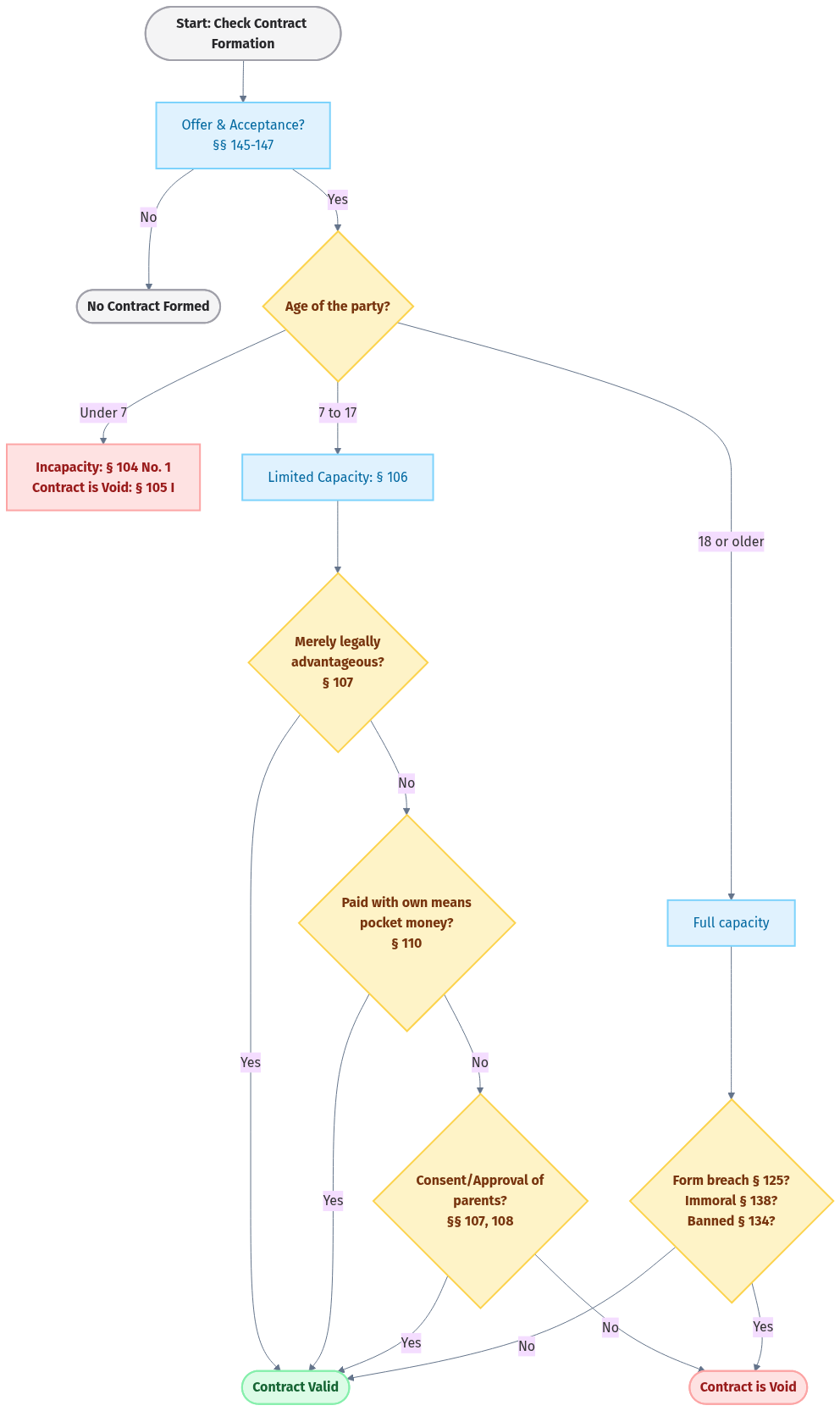
Mermaid Code
flowchart TD


    Start([Start: Check Contract Formation]) --> Offer[Offer & Acceptance? <br>§§ 145-147]
    Offer -- No --> NoContract([No Contract Formed])
    Offer -- Yes --> AgeCheck{Age of the party?}

    AgeCheck -- Under 7 --> Incapable[Incapacity: § 104 No. 1<br>Contract is Void: § 105 I]
    AgeCheck -- 7 to 17 --> LimitedCapacity[Limited Capacity: § 106]
    AgeCheck -- 18 or older --> FullCapacity[Full capacity]

    LimitedCapacity --> Advantage{Merely legally <br>advantageous? <br>§ 107}
    Advantage -- Yes --> ContractValid([Contract Valid])
    Advantage -- No --> PocketMoney{Paid with own means <br>pocket money? <br>§ 110}

    PocketMoney -- Yes --> ContractValid
    PocketMoney -- No --> Representation{Consent/Approval of <br>parents? <br>§§ 107, 108}

    Representation -- Yes --> ContractValid
    Representation -- No --> VoidContract([Contract is Void])

    FullCapacity --> ValidityCheck{Form breach § 125?<br>Immoral § 138?<br>Banned § 134?}
    ValidityCheck -- Yes --> VoidContract
    ValidityCheck -- No --> ContractValid

    classDef startEnd fill:#f4f4f5,stroke:#a1a1aa,stroke-width:2px,color:#27272a,font-weight:bold;
    classDef decision fill:#fef3c7,stroke:#fcd34d,stroke-width:2px,color:#78350f,font-weight:bold;
    classDef process fill:#e0f2fe,stroke:#7dd3fc,stroke-width:2px,color:#0369a1;
    classDef void fill:#fee2e2,stroke:#fca5a5,stroke-width:2px,color:#991b1b,font-weight:bold;
    classDef success fill:#dcfce7,stroke:#86efac,stroke-width:2px,color:#166534,font-weight:bold;

    class Start,NoContract startEnd;
    class AgeCheck,Advantage,PocketMoney,Representation,ValidityCheck decision;
    class Offer,LimitedCapacity,FullCapacity process;
    class Incapable,VoidContract void;
    class ContractValid success;
Diagram B: The Avoidance Algorithm (Anfechtung)
Use this workflow when a party wants to back out of a contract due to mistakes, deceit, or duress under § 142 BGB.
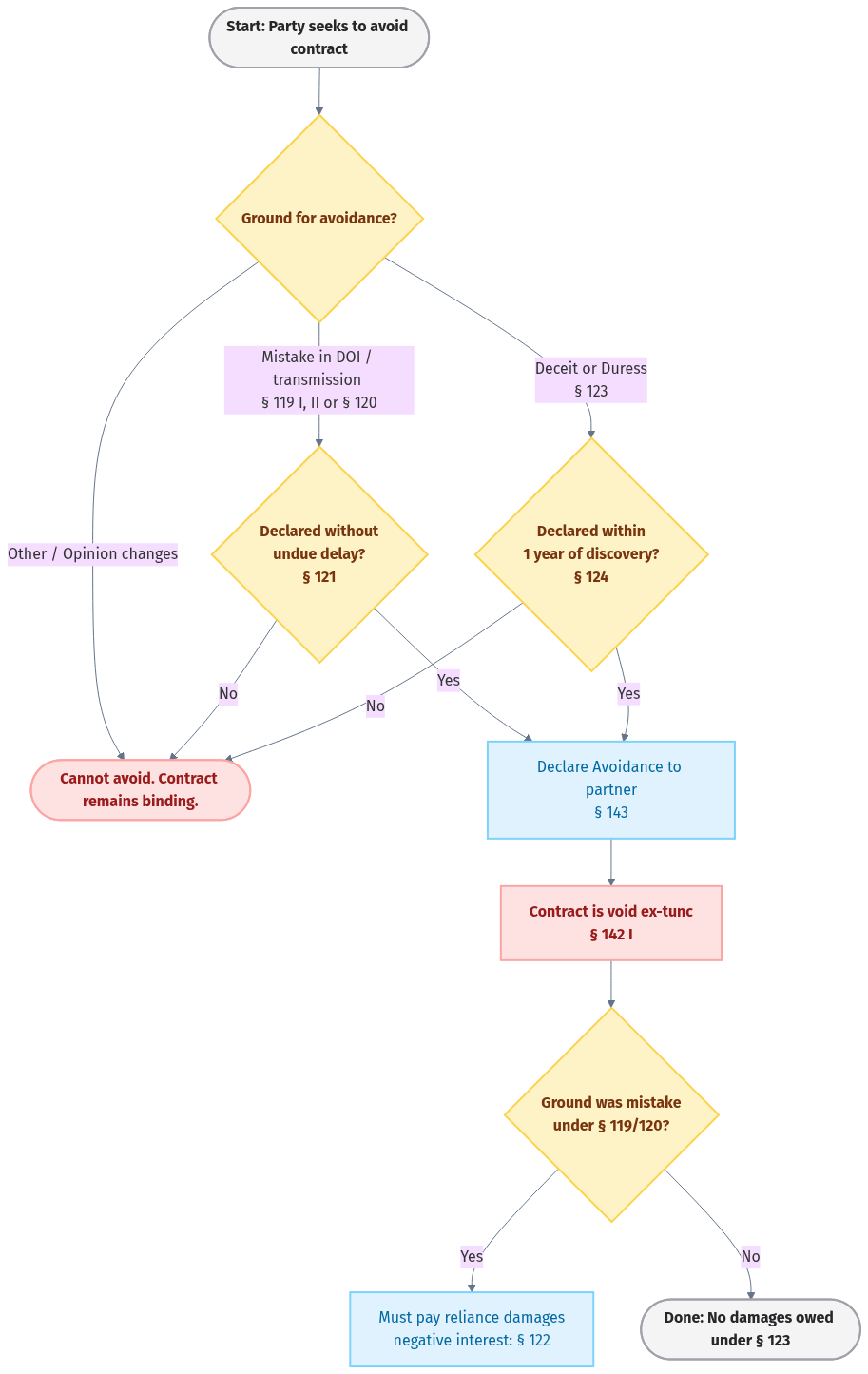
Mermaid Code
flowchart TD


    Start([Start: Party seeks to avoid contract]) --> Ground{Ground for avoidance?}

    Ground -- Mistake in DOI / transmission <br>§ 119 I, II or § 120 --> DeadlineMistake{Declared without <br>undue delay?<br>§ 121}
    Ground -- Deceit or Duress <br>§ 123 --> DeadlineDeceit{Declared within <br>1 year of discovery?<br>§ 124}
    Ground -- Other / Opinion changes --> NoAvoid([Cannot avoid. Contract remains binding.])

    DeadlineMistake -- No --> NoAvoid
    DeadlineMistake -- Yes --> Declare[Declare Avoidance to partner<br>§ 143]

    DeadlineDeceit -- No --> NoAvoid
    DeadlineDeceit -- Yes --> Declare

    Declare --> VoidExtunc[Contract is void ex-tunc<br>§ 142 I]

    VoidExtunc --> CheckDamages{Ground was mistake <br>under § 119/120?}
    CheckDamages -- Yes --> RelianceDamages[Must pay reliance damages<br>negative interest: § 122]
    CheckDamages -- No --> Done([Done: No damages owed under § 123])

    classDef startEnd fill:#f4f4f5,stroke:#a1a1aa,stroke-width:2px,color:#27272a,font-weight:bold;
    classDef decision fill:#fef3c7,stroke:#fcd34d,stroke-width:2px,color:#78350f,font-weight:bold;
    classDef process fill:#e0f2fe,stroke:#7dd3fc,stroke-width:2px,color:#0369a1;
    classDef void fill:#fee2e2,stroke:#fca5a5,stroke-width:2px,color:#991b1b,font-weight:bold;
    classDef success fill:#dcfce7,stroke:#86efac,stroke-width:2px,color:#166534,font-weight:bold;

    class Start,Done startEnd;
    class Ground,DeadlineMistake,DeadlineDeceit,CheckDamages decision;
    class Declare,RelianceDamages process;
    class NoAvoid,VoidExtunc void;
Diagram C: Breach of Duty & Damage Claims
This flowchart navigates through general contract breach claims (§ 280 I BGB) to determine what types of damages apply.
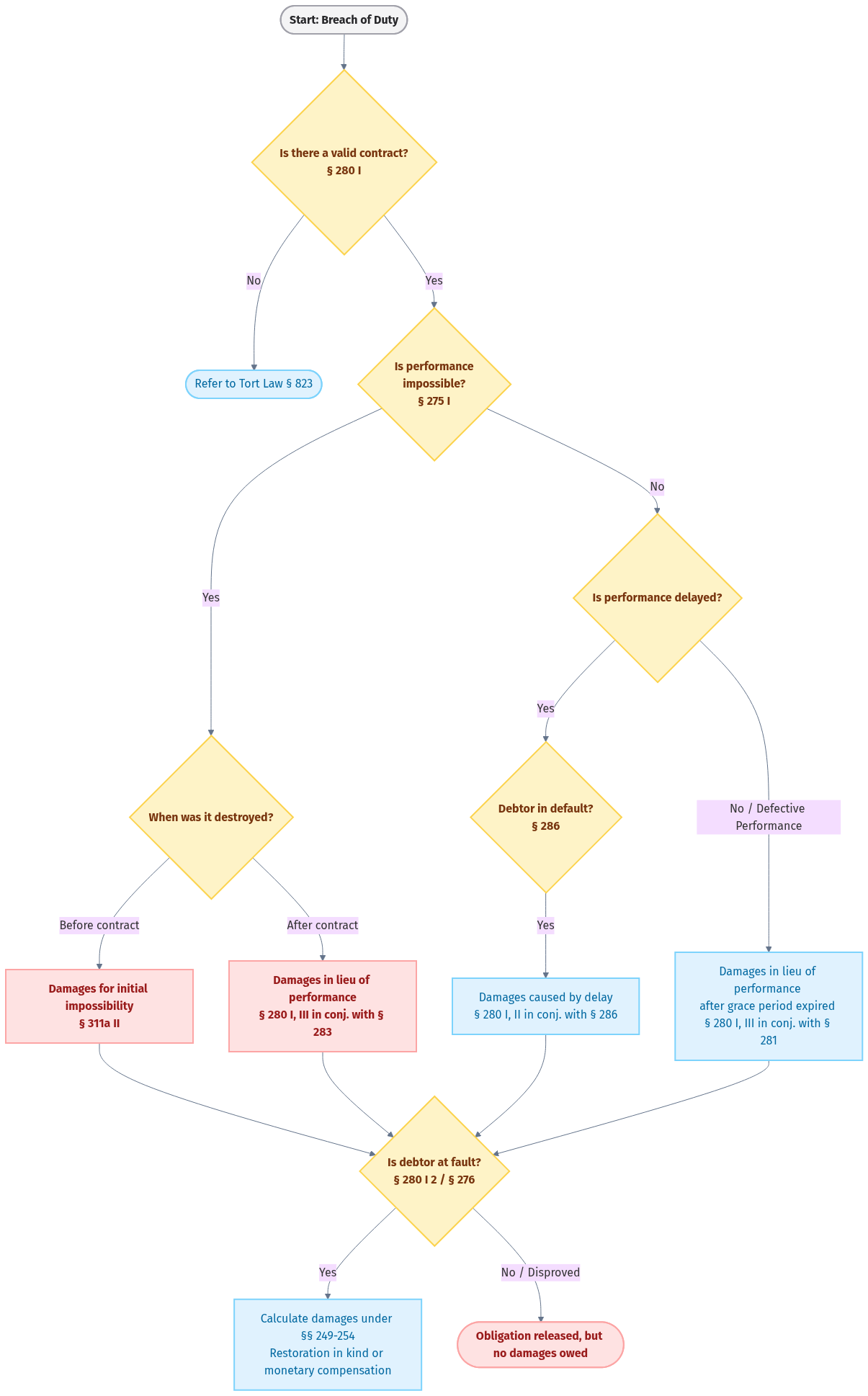
Mermaid Code
flowchart TD


    Start([Start: Breach of Duty]) --> ContractCheck{Is there a valid contract?<br>§ 280 I}
    ContractCheck -- No --> TortCheck([Refer to Tort Law § 823])
    ContractCheck -- Yes --> Impossibility{Is performance <br>impossible?<br>§ 275 I}

    Impossibility -- Yes --> Cause{When was it destroyed?}
    Cause -- Before contract --> InitialImp[Damages for initial impossibility<br>§ 311a II]
    Cause -- After contract --> SubsequentImp[Damages in lieu of performance<br>§ 280 I, III in conj. with § 283]

    Impossibility -- No --> Timing{Is performance delayed?}
    Timing -- Yes --> Default{Debtor in default?<br>§ 286}
    Default -- Yes --> DelayDamages[Damages caused by delay<br>§ 280 I, II in conj. with § 286]

    Timing -- No / Defective Performance --> GeneralBreach[Damages in lieu of performance <br>after grace period expired <br>§ 280 I, III in conj. with § 281]

    InitialImp & SubsequentImp & DelayDamages & GeneralBreach --> FaultCheck{Is debtor at fault?<br>§ 280 I 2 / § 276}
    FaultCheck -- Yes --> DamagesCalc[Calculate damages under §§ 249-254<br>Restoration in kind or monetary compensation]
    FaultCheck -- No / Disproved --> NoDamages([Obligation released, but no damages owed])

    classDef startEnd fill:#f4f4f5,stroke:#a1a1aa,stroke-width:2px,color:#27272a,font-weight:bold;
    classDef decision fill:#fef3c7,stroke:#fcd34d,stroke-width:2px,color:#78350f,font-weight:bold;
    classDef process fill:#e0f2fe,stroke:#7dd3fc,stroke-width:2px,color:#0369a1;
    classDef void fill:#fee2e2,stroke:#fca5a5,stroke-width:2px,color:#991b1b,font-weight:bold;
    classDef success fill:#dcfce7,stroke:#86efac,stroke-width:2px,color:#166534,font-weight:bold;

    class Start startEnd;
    class ContractCheck,Impossibility,Cause,Timing,Default,FaultCheck decision;
    class TortCheck,DelayDamages,GeneralBreach,DamagesCalc process;
    class InitialImp,SubsequentImp,NoDamages void;
Diagram D: Buyer’s Warranty Workflow (Sales defects)
When goods have material defects under § 434 BGB, this chart maps the path to remedies under § 437 BGB.
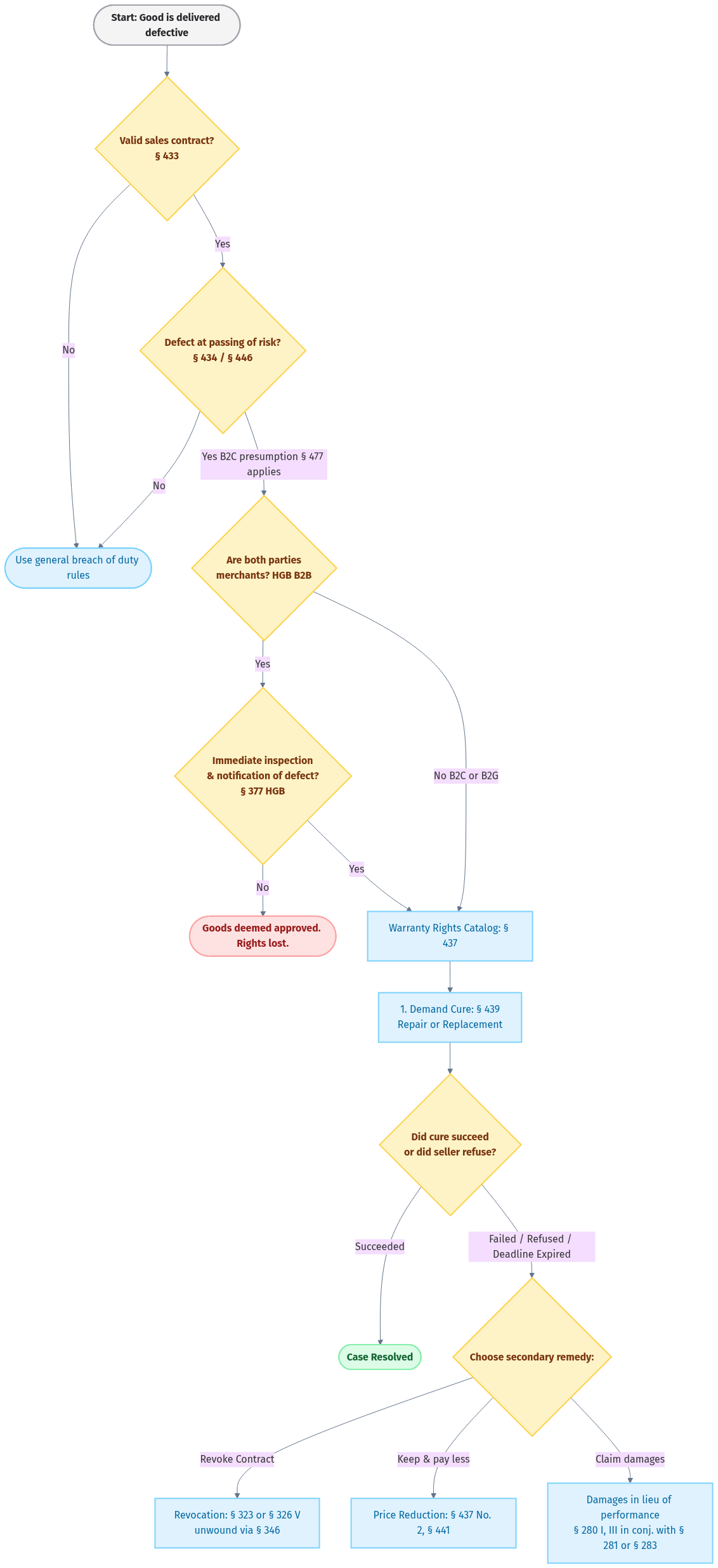
Mermaid Code
flowchart TD


    Start([Start: Good is delivered defective]) --> SalesContract{Valid sales contract?<br>§ 433}
    SalesContract -- No --> GeneralRules([Use general breach of duty rules])
    SalesContract -- Yes --> DefectCheck{Defect at passing of risk?<br>§ 434 / § 446}

    DefectCheck -- No --> GeneralRules
    DefectCheck -- Yes B2C presumption § 477 applies --> B2BCheck{Are both parties <br>merchants? HGB B2B}

    B2BCheck -- Yes --> Rügepflicht{Immediate inspection <br>& notification of defect?<br>§ 377 HGB}
    Rügepflicht -- No --> DeemedApproved([Goods deemed approved. Rights lost.])
    Rügepflicht -- Yes --> WarrantyRights
    B2BCheck -- No B2C or B2G --> WarrantyRights

    WarrantyRights[Warranty Rights Catalog: § 437] --> Cure[1. Demand Cure: § 439<br>Repair or Replacement]
    Cure --> CureResult{Did cure succeed <br>or did seller refuse?}

    CureResult -- Succeeded --> CaseDone([Case Resolved])
    CureResult -- Failed / Refused / Deadline Expired --> RemedyOptions{Choose secondary remedy:}

    RemedyOptions -- Revoke Contract --> Revoke[Revocation: § 323 or § 326 V <br> unwound via § 346]
    RemedyOptions -- Keep & pay less --> Reduce[Price Reduction: § 437 No. 2, § 441]
    RemedyOptions -- Claim damages --> ClaimDamages[Damages in lieu of performance<br>§ 280 I, III in conj. with § 281 or § 283]

    classDef startEnd fill:#f4f4f5,stroke:#a1a1aa,stroke-width:2px,color:#27272a,font-weight:bold;
    classDef decision fill:#fef3c7,stroke:#fcd34d,stroke-width:2px,color:#78350f,font-weight:bold;
    classDef process fill:#e0f2fe,stroke:#7dd3fc,stroke-width:2px,color:#0369a1;
    classDef void fill:#fee2e2,stroke:#fca5a5,stroke-width:2px,color:#991b1b,font-weight:bold;
    classDef success fill:#dcfce7,stroke:#86efac,stroke-width:2px,color:#166534,font-weight:bold;

    class Start,CaseDone startEnd;
    class SalesContract,DefectCheck,B2BCheck,Rügepflicht,CureResult,RemedyOptions decision;
    class GeneralRules,WarrantyRights,Cure,Revoke,Reduce,ClaimDamages process;
    class DeemedApproved void;
    class CaseDone success;
3. Related Exam-Relevant Topics (Missing from Summaries)
These sections and concepts are heavily queried in TUM business law exams but were not explicitly detailed in your summary notes.
A. Commercial Agency & Representation (HGB)
- Prokura (Power of Attorney) — §§ 48–53 HGB:
- Statutory Scope: The holder of a Prokura (Prokurist) is legally authorized to execute all types of transactions that the operation of any commercial business entails (§ 49 I HGB).
- Real Estate Limitation: A Prokurist cannot sell or encumber real estate without specific extra authorization (§ 49 II HGB).
- External Indivisibility: The scope of Prokura cannot be limited with effect against third parties (§ 50 I, II HGB). Any internal restriction (e.g., “do not sign contracts over €50k”) is legally irrelevant to third-party contract partners.
- Handlungsvollmacht — § 54 HGB:
- A commercial power of attorney that is less broad than Prokura. It only covers transactions typical for this specific type of business (e.g., a store manager). Limitations are effective against third parties if they knew or negligently ignored them.
- Shop Employee Authority — § 56 HGB:
- A person employed in a shop or warehouse is legally presumed to have the power to sell and deliver goods. In exams, this validates purchases made from sales clerks who might not have explicit individual authority.
B. Property Law (Sachenrecht) & Ownership Transfer
- Abstraction and Separation Principles:
- Entering into a contract (e.g., § 433 BGB) is the obligational transaction (Verpflichtungsgeschäft). Transferring ownership (e.g., § 929 BGB) is the disposal transaction (Verfügungsgeschäft). They are legally separate.
- If the obligational contract is void from the start (e.g., due to usury or subsequent avoidance), the property transfer remains valid. The buyer still owns the good, but the seller has a claim to get it back under unjust enrichment (§ 812 BGB).
- Alternative Property Transfers:
- § 930 BGB (Possession Medium / Besitzkonstitut): The seller transfers ownership to the buyer but keeps physical custody (e.g., leaseback or security transfer / Sicherungsübereignung).
- § 931 BGB (Claim Assignment / Abtretung): The seller transfers ownership of an item currently held by a third party by assigning their return claim to the buyer.
- Good Faith Acquisition — § 932 BGB:
- If a seller sells a good they do not own, a buyer in good faith (who does not know/have reason to know the seller isn’t the owner) still legally becomes the owner upon delivery.
- Exclusion of Good Faith Acquisition — § 935 BGB:
- Good faith acquisition is impossible if the item was stolen, lost, or otherwise went missing (abhandengekommen) from the original owner.
C. General BGB Mechanics
- B2B Standard Terms Restriction — § 310 I BGB:
- Unjust Enrichment Details — § 812 I 1 Alt. 1 BGB:
- Leistungskondiktion: Reclaiming something transferred to another party “through performance” when the contract turns out to be void.
- Defense of Loss of Enrichment (§ 818 III BGB): The recipient does not have to return the value if they no longer have it and spent it on something they wouldn’t have otherwise bought (e.g., a luxury vacation in good faith).
- Set-off (Aufrechnung) — §§ 387, 388 BGB:
- Extinguishing mutual claims of the same kind. If A owes B €100 and B owes A €100, either party can declare a set-off to cancel the debts.
D. Corporate Liability basics
- Partnership Liability — § 128 HGB (old) / § 124 HGB (reformed):
- Partners of an oHG (and GbR partners under reformed law) are personally, directly, jointly, and severally liable for all company liabilities.
- Limited Partner Liability — § 171 I HGB:
- A limited partner (Kommanditist in a KG) is only liable up to their registered contribution. Once paid to the company, their personal liability is fully excluded.