Hand-crafted by Flo, auto-checked by AI.
Resources
Under which circumstances in where in the life-cycle of an innovation can a company profit, as well as how and why others may benefit and the effects on commercialization choices. This is based on David Teece’s Profiting from Innovation (PFI) framework.
Profitable Innovation
Conditions
For an innovation to be profitable, it must either be a new technology for a suitable market, or a suitable technology on a new market. Additionally, profits must be appropriatable for the innovation to be profitable.
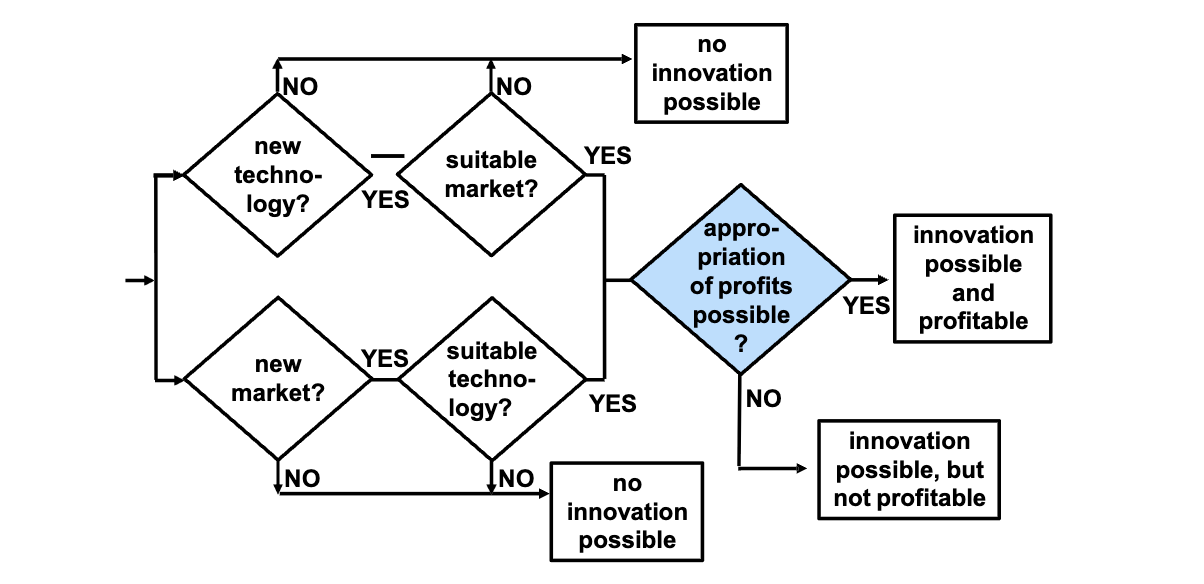
Additionally, an innovation’s profitability depends on three primary factors: The appropriability regime, its life-cycle phase, and complementary assets.
Appropriability Regime
The factors that influence the possibility of profitably imitating an innovation. This includes:
- Availability and strength of legal protection
- Viability of secrecy
- Complexity and other characteristics of the underlying technology
- Imitation costs: Network effects, switching costs, scale effects, ease of market entry
For example, pharmaceuticals have strong legal protection through patents, brand recipes may rely on secrecy, and complex technologies may be difficult to imitate. Software often has weak appropriability due to ease of imitation.
Life-Cycle Phase
Teece (1986) distinguishes two design phases for industries where products are imitable:
- Pre-Paradigmatic Design Phase: Before a dominant design is established, an Innovator’s success depends on their ability to make their technology the dominant one.
- Paradigmatic Design Phase: After a dominant design is established, an Innovator’s success depends on their control of complementary assets.
Complementary Assets
To commercialize the core technological know-how of the innovation, complementary assets are required:
- Competitive Manufacturing
- Distribution
- Service
- Complementary Technologies
- etc.
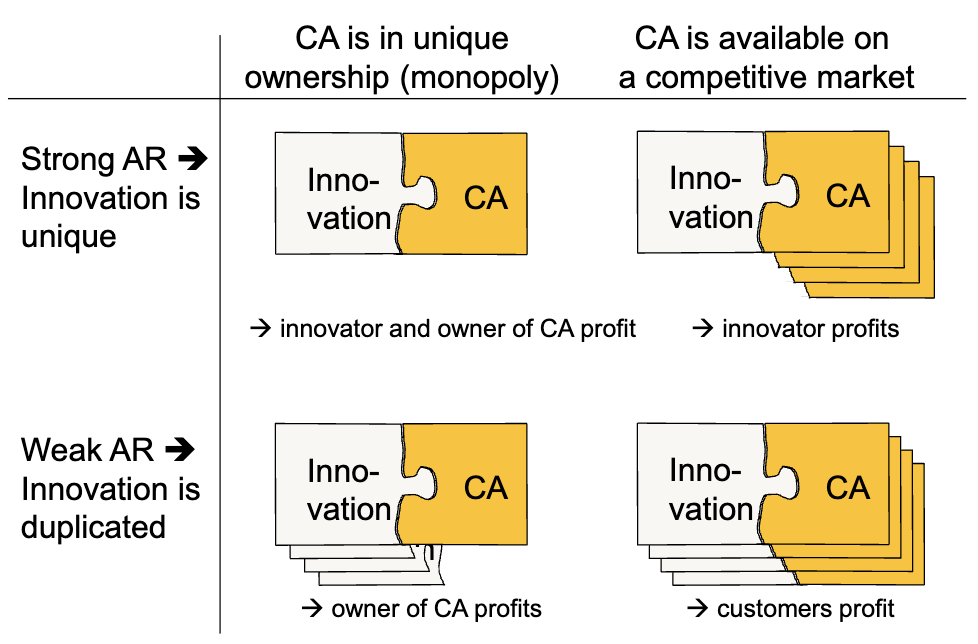
The distribution of profits between the innovator and the owner of complementary assets (CA) depends on the availability of complementary assets, as well as the Appropriability Regime:
- Strong AR + Unique CA: Both profit; the technology is legally protected from imitators and the rare complementary asset creates a highly profitable bottleneck.
- Strong AR + Competitive CA: The innovator profits; the unique technology cannot be legally copied, while the required assets are commodities that can be cheaply outsourced.
- Weak AR + Unique CA: The asset owner profits; imitators quickly copy the unprotected technology, shifting all leverage to whoever controls the exclusive bottleneck.
- Weak AR + Competitive CA: The customers profit; anyone can replicate the tech and access the assets, triggering intense competition that drives prices down.
Dependance of Innovation and Complementary Assets
Innovation and complementary assets can depend on each other in different ways:
- Generic: The innovation can be commercialized with generic complementary assets.
- Specialized on the innovation: The complementary assets are designed to work with the specific innovation.
- Specialized on the complementary assets: The innovation is designed to work with specific complementary assets.
- Co-specialized: The innovation and complementary assets are designed to work together and are not easily separated.
Beneficiaries
The innovator usually benefits, but is not the only beneficiary:
- Innovators: By selling the innovation, or by using it to gain a competitive advantage (e.g. Sovaldi, a pharmaceutical).
- Suppliers: By selling larger quantities to the innovator, or by charging higher prices for their inputs (e.g. aluminium producers from aluminium cans).
- Complementors: By selling complementary products or services to the innovator (e.g. app developers on mobile platforms).
- Customers: By gaining access to superior products or services, or by paying lower prices (e.g. seat belts).
- Imitators: By marketing the imitation and saving on R&D (e.g. Apple turning Xerox’s GUI into a successful product).
Example Model: Supplier Benefits
Given an innovator facing a demand cure of with an option to innovate at a marginal cost of (other costs are zero) for good , which is produced at zero cost sold by the monopolistic supplier .
Therefore, the innovators profit is given by:
The profit-maximizing quantity is then at the point where the first-order condition (derivate) is zero. Solving it for reveals the innovators reaction function; how much they will buy depending on price.
Since the supplier’s cost to produce is zero, its profit is simply the price times the quantity sold. Use the first-order condition to find the supplier’s optimal price:
Therefore, in this example, the supplier achieves twice the profit of the innovator (, ). This is because the supplier has a monopoly on the input and can charge a high price, while the innovator’s profit is limited by the demand curve and the price they have to pay for the input.
The basic principles here are explained in Production and Supply. According to the lecture, simple models like this one are often part of the exam.
Innovators vs Imitators
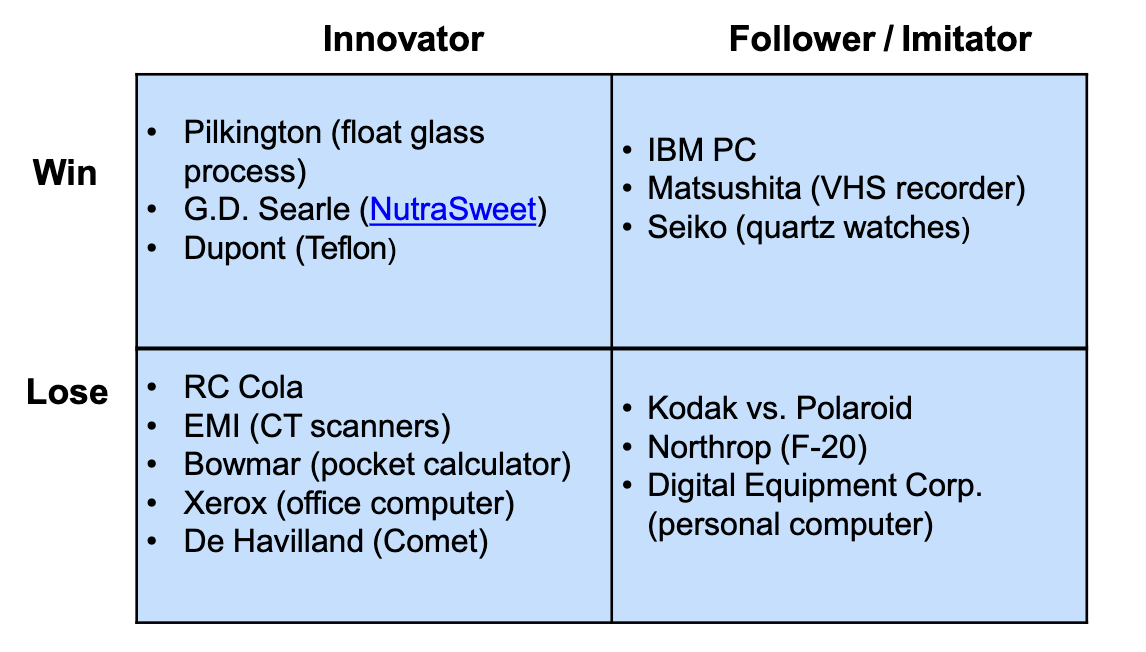
Both innovators and imitators may win by innovating or imitating, respectively. However, innovators have first-mover and intellectual property advantages, while imitators can save on R&D costs and learn from the innovator’s mistakes. The distribution of profits between innovators and imitators depends on factors such as the strength of intellectual property protection, the speed of imitation, and the market dynamics.
Complementary Assets: Contracting
Contracting complementary assets has lower capital requirements than integrating them and brings reputational gain to the smaller partner, but may be difficult for specialized assets, eases imitation, and creates a dependence on the contract partner. Integration, on the other hand, consumes more time and capital and is difficult to reverse, but can make imitation more difficult.
Hold-Up Issues
For specialized complementary assets, hold-up issues should be considered. These arise when one party makes relationship-specific investments that are not easily redeployable, giving the other party leverage to renegotiate terms or extract more value. To mitigate hold-up issues, companies can use strategies such as vertical integration, long-term contracts with clear terms, or building strong relationships with complementary asset providers.
Co-Operating and Competing
When entrepreneurs want to profit from an innovation, they can sell products/services or intangibles like the technological idea:
- Product Market: Compete with or complement existing products. Incumbents may be risk-averse and slow to respond, therefore market entry should be aggressive, establish a market presence, persuade customers of novelty of offering, gaining access to enforceable PR, and avoiding detection by incumbents.
- Idea Market: Sell ideas or company; make alliances to compete on the product market. Includes licensing, selling firm to incumbents, joint ventures or strategic alliances.
Cooperating on the Idea Market
Benefits of Cooperation
- Potential benefits are shared: Less competition for Schumpeterian rents (profits from innovation)
- Possibility to build upon on other firms’ existing competencies
- Avoids catch-up costs
Risks of Cooperation
- Disclosure Paradox: Sharing information is necessary for cooperation, but it can also lead to imitation and loss of competitive advantage. Without IP protection, firms may be hesitant to share information, which can hinder cooperation and innovation.
- Bargaining Power: The party with more bargaining power may capture a larger share of the profits, leading to an unequal distribution of benefits and potential conflicts.
- Finding partners and negotiating agreements can be time-consuming and costly