Hand-crafted by Flo, auto-checked by AI.
Resources
Innovation - both itself, as well as their diffusion and impact - is often subject to certain patterns, which can often only be established in hindsight. Therefore, given evidence a pattern will apply or is established, firms can account for this using innovation management.
Long-Term Patterns
Technological development is not a smooth process, but rather characterized by waves of technological revolutions triggered by revolutionary changes, for example the printing press or the internet. These revolutions are often followed by periods of incremental innovation, which can be seen as a process of creative destruction , where new technologies replace old ones and create new markets and industries.
Cumulative and Evolutional Innovation
Cumulative innovation refers to the process of building on existing knowledge and technologies to create new products, processes, or services. Evolutional innovation, on the other hand, refers to the process of making incremental improvements to existing products, processes, or services.
Kondratiev Long Waves
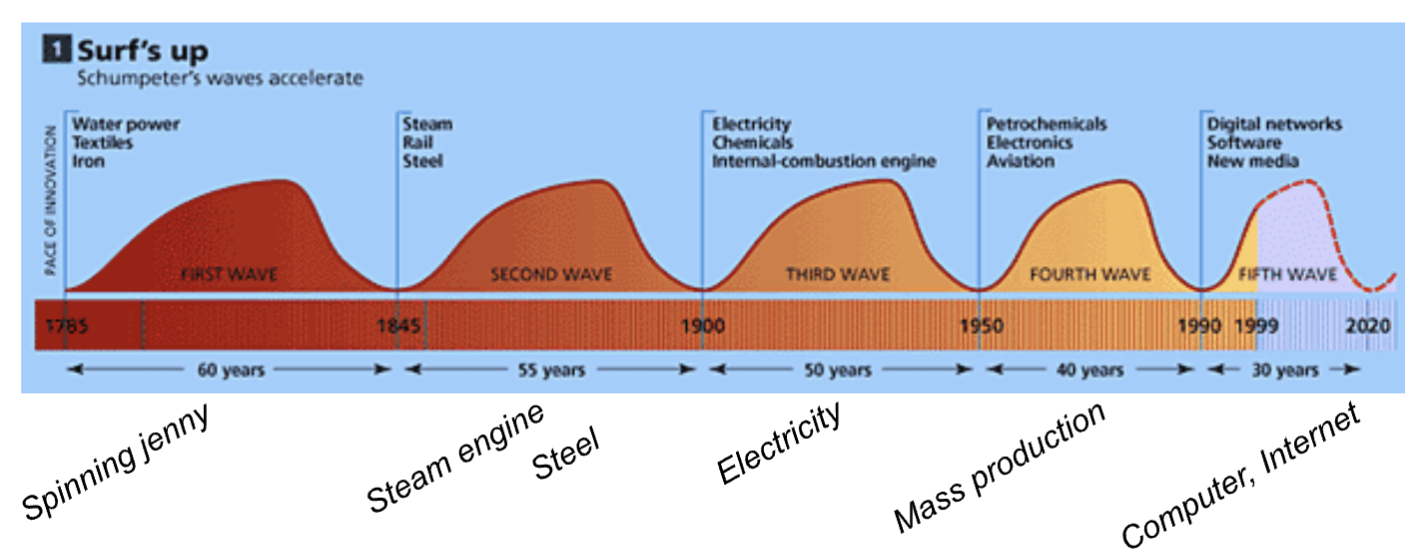
An observation that over the past centuries, revolutionary innovations have occurred in waves of approximately 50 years, followed by periods of incremental innovation. These waves are often associated with major technological revolutions that have transformed economies and societies.
Revolutionary Innovations
- Printing press (15th century): Mass production of books and dissemination of knowledge.
- Spinning Jenny (18th century): Revolutionized textile production for the Industrial Revolution.
- Steam Engine (18th century): Transformed transportation and manufacturing.
- Internet (20th century): Revolutionized communication, commerce, and information sharing.
Consequences
When a new wave of technological revolution occurs, it can lead to significant changes in the economy and society, including:
- Redesign or new configurations of capital stock
- Industrial relations
- Regulations
- Labor skills
Therefore, competitiveness is based on knowledge, creativity and learning, as well as innovation and R&D.
Role of Government
The state can support and influence innovation through various policies and initiatives, such as funding research and development, providing tax incentives for innovation, and creating a favorable regulatory environment for innovation. Funding can also offset the externality of spillover effects of R&D - where benefits flow to other firms and individuals beyond the innovating firm - and thus encourage more investment in innovation.
Technological Innovation
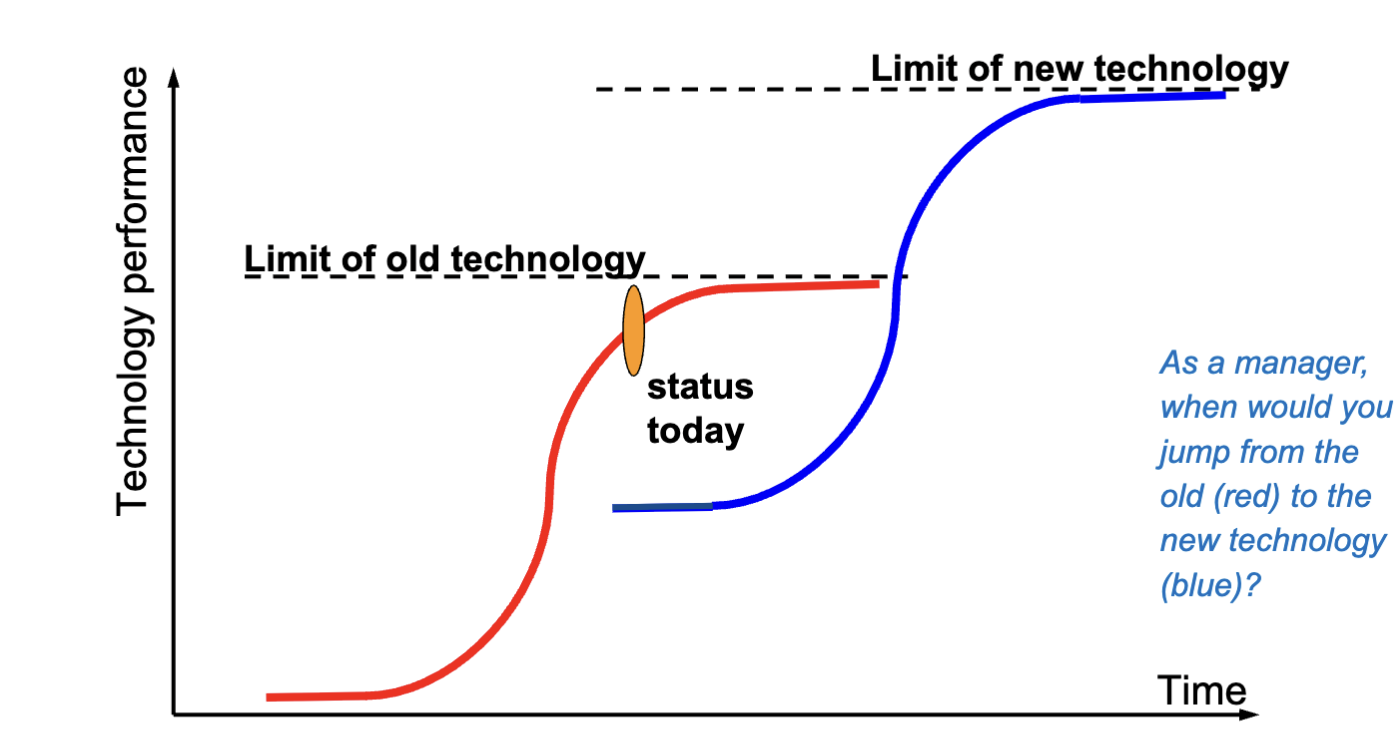
Technology often develops along an S-curve - slow at start and end, with rapid growth in between. This causes a conflict between the need for incremental innovation to improve existing technologies and the need for radical innovation to develop (or jump on) new technologies. The new technology is commonly inferior at first, but has more potential for improvement.
Product Innovation
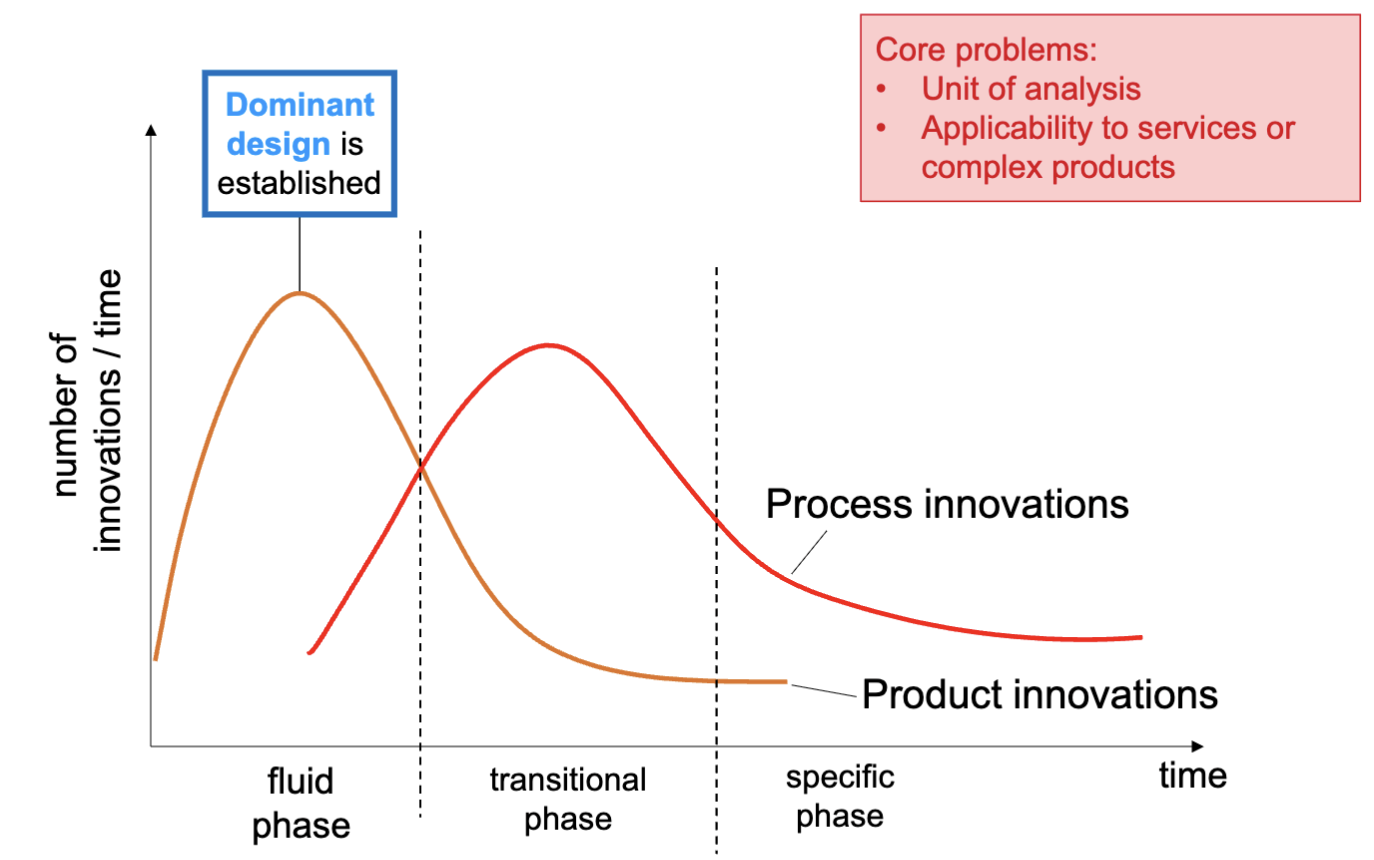
Product innovation revolves around three specific phases:
- Fluid Phase: The early stage of a new product, where there is a lot of uncertainty and experimentation. The product is often not fully developed and may not have a clear market fit. Eventually, a dominant design takes over the market, which is the standard design that most firms follow.
- Transitional Phase: The stage where the dominant design is established, and firms focus on improving and refining the product. There is less experimentation and more incremental innovation. Finally, process innovations emerge, which are improvements in the production process that reduce costs and increase efficiency.
- Specific Phase: The stage where the product is mature, and there is little room for improvement. Firms focus on cost reduction and differentiation, and there is often a decline in innovation.
| Dimension | Stage 1: Fluid | Stage 2: Transitional | Stage 3: Specific |
|---|---|---|---|
| Innovation | Frequent major product changes | Major process changes required by rising demand | Incremental for product and cumulative improvements |
| Products | Diverse design, often customised | One product design, stable enough for volume | Mostly undifferentiated, standard products |
| R&D | Focus unspecified because of uncertainty | Focused on specific product features | Focus on incremental product technologies |
| Plant | Small scale, located near user | General-purpose with specialised sections | Large-scale, highly specific to product |
| Costs of process change | Low | Medium | High |
| Basis of competition | Functionally product performance | Product variation | Price |
| Vulnerabilities of industry leaders | To imitators and to successful breakthroughs | To more efficient and higher quality producers | To technological innovations that present superior product substitutes |
| Organisational control | Informal and entrepreneurial | Through project and task groups | Structure, rules and goals |
Adoption: Roger’s Diffusion
Roger’s diffusion model categorizes adopters of innovation into five groups based on their willingness to adopt new technologies:
- Innovators: The first individuals to adopt an innovation. They are willing to take risks and are often seen as visionaries. Often cosmopolite social relationships, they have a gatekeeping role in the flow of new ideas.
- Early Adopters: The second group to adopt an innovation. They are often opinion leaders and are more socially connected than innovators. They have a high degree of influence over the adoption decisions of others.
- Early Majority: Regular users, but curious about the new. They are more cautious than early adopters and tend to adopt innovations after a significant portion of the population has already adopted them.
- Late Majority: Skeptical and adopt only after the majority has adopted. They are often influenced by peer pressure and economic necessity.
- Laggards: The last group to adopt an innovation. They are resistant to change and may only adopt an innovation when it becomes absolutely necessary.
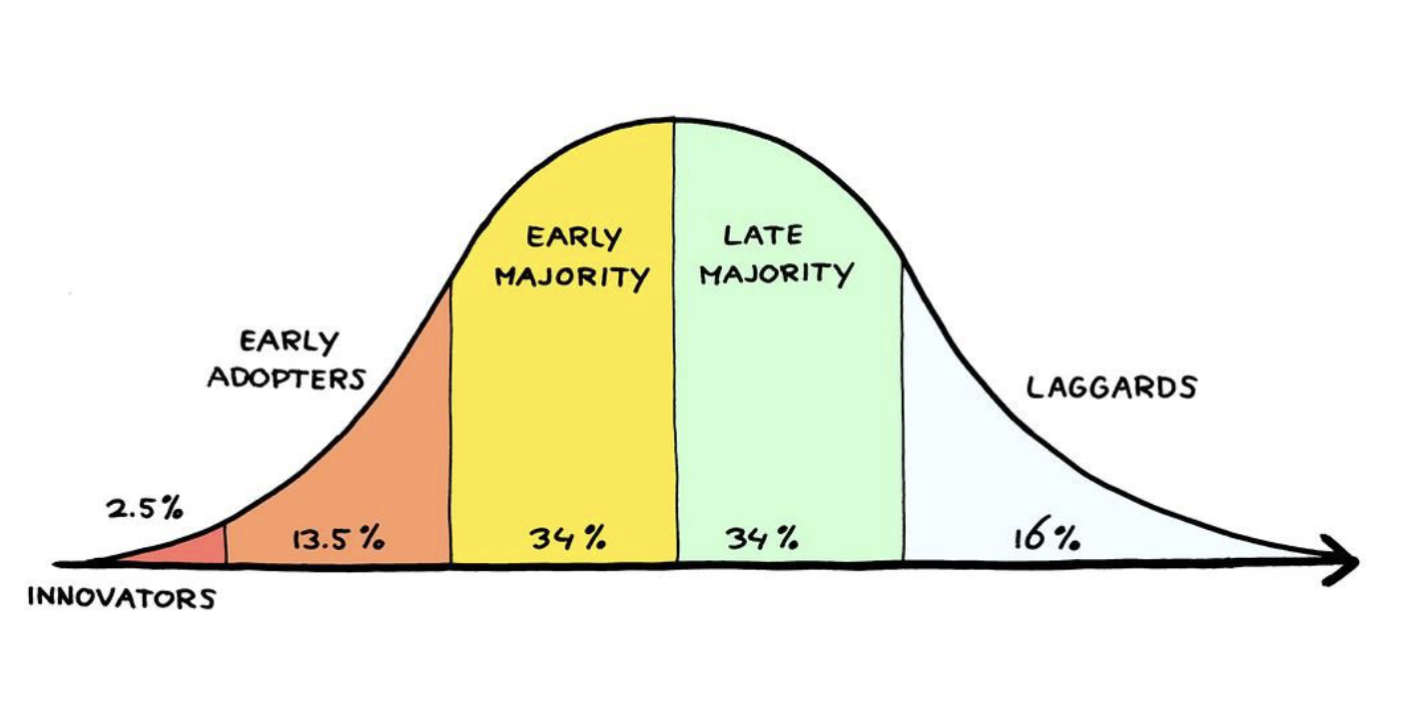
When analyzing actual adoption of new technologies, this often closely follows this diffusion curve, which is a function defined by its differential equation. In the lecture, examples of VCR ad answering machines were given.
Diffusion Methods
Diffusion can be mathematically modeled as a differential equation where represents the change in the number of adopters over a short time period , with statistical constants and for initial conditions and behavioral weights.
- Pure Independent Adoption (Linear Growth): Sequence of independent decisions without imitation; ignores the finite market size ();
- Independent Adoption with Finite Market (Negative Exponential Growth): Accounts for a finite market; growth slows down as the remaining pool of potential adopters shrinks;
- Pure Imitation / Learning Curve (Unbounded Exponential Growth): Driven purely by network effects or learning from others; ignores market limits;
- Logistic Growth Model (S-Curve): Combines imitation/learning with a finite market limit, generating a symmetric S-curve;
- Bass Diffusion Model (Mixed Model): Comprehensive model combining independent adoption (coefficient p) and imitation/network effects (coefficient q) within a finite market;