Hand-crafted by Flo, auto-checked by AI.
Resources
Innovation is Complex and Difficult
- Risky (technology, demand, competition)
- Potentially Costly
- Might be better if low-tech instead of high-tech
- Often outside of routine business operations
- Usually based on cooperation of many actors and business functions
- Creative disruption often causes resistance
- However, it is necessary and hugely profitable (e.g. Prozac), incentivized by capitalism
Innovation management requires different skills, tools, incentives and processes than routine business management.
What is Innovation?
- New product or process; differing significantly from what existed before (Hauschildt)
- A new way of doing things that is commercialized (Porter)
- The adoption of ideas that are new to the adopting organization (Afuah)
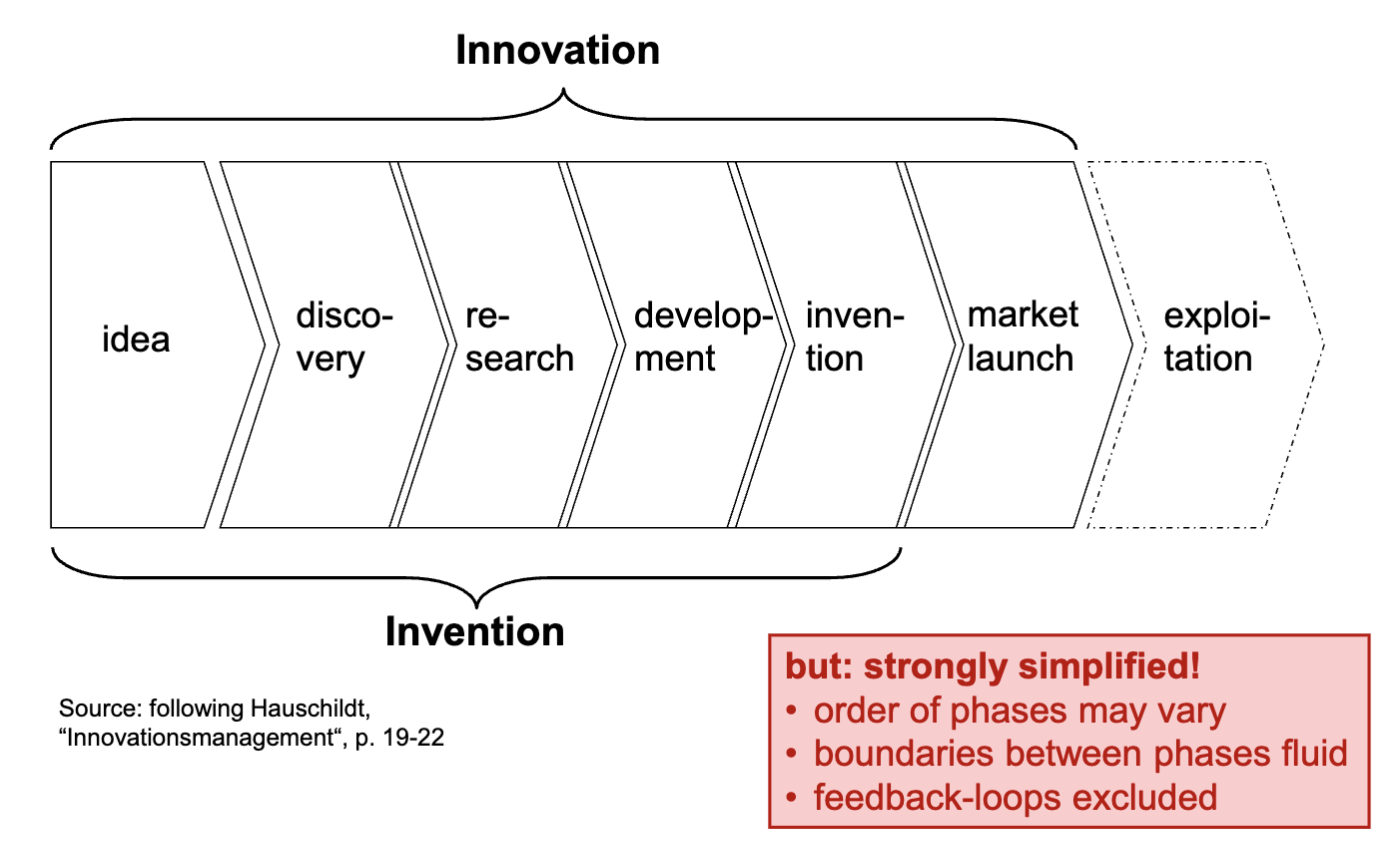
Innovation and Invention
- Not all inventions are innovations, for example a helium-filled umbrella: It’s new, but not useful.
- Innovation is not necessarily about technology: The standard mouse trap design was an innovation, but not a technological one.
Types of Innovation
While it can be difficult to distinguish between the different types, for example because product and process innovation often go hand in hand, or because a product innovation for a supplier can be a process innovation for the buyer, three general categories exist:
Product or Service Innovation
A new product or service is created to generate or increase sales, for which it must be sold on a market. For example, the iPhone was an innovation because it created a new market for smartphones. In contrast, the first mobile phone (the DynaTAC) was an invention but not an innovation, as it was not commercially successful.
Process Innovation
A new process is created to enable or improve the production of goods or services, for which it must be established inside the organization. For example, the assembly line was a process innovation that allowed for mass production of cars. In contrast, the first sewing machine was an invention but not a process innovation, as it did not change the way clothes were made.
Business Model Innovation
A new way of doing business is created to generate revenues and define value propositions for customers/suppliers/partners. For example, the subscription model for software (e.g., Adobe Creative Cloud) was a business model innovation that changed how software is sold and used. In contrast, the first software (e.g., Microsoft Word) was an invention but not a business model innovation, as it did not change the way software was monetized.
Sources of Innovation
Basic Research
Often funded by public institutions, this is experimental or theoretical work undertaken primarily to acquire new knowledge without any particular application or use in view. For example, research on quantum mechanics was basic research that later enabled the development of semiconductors and thus modern electronics.
Applied Research
This is original investigation undertaken to acquire new knowledge with a specific application in view. For example, research on improving battery technology was applied research that led to the development of lithium-ion batteries used in electric vehicles.
Experimental Development Research
Systematic work usually conducted by companies, drawing on existing knowledge, to produce new or significantly improved products, processes, or services. For example, the development of the COVID-19 vaccines involved experimental development research that built on existing knowledge of mRNA technology.