Resources
IP protection is a crucial aspect of innovation management, as it safeguards the rights of creators and innovators. Intellectual property encompasses various forms of intangible assets, including patents, trademarks, copyrights, and trade secrets. Effective IP protection encourages innovation by providing legal recognition and exclusive rights to inventors and creators, enabling them to profit from their work while preventing unauthorized use or reproduction. The IPR of others contains valuable information.
IP Protection
Formal IP protection can take several forms, each with its own legal framework and requirements:
- Patents: Protect inventions and grant exclusive rights to the inventor for a specified period, in Germany usually 20 years from the filing date. Patents require a formal application and examination process.
- Registered Designs: Protect the visual design of objects, granting exclusive rights to the creator for a limited time, usually 25 years in Germany.
- Trademarks: Protect brand names, logos, and other identifiers that distinguish goods or services. Trademarks can be registered and renewed indefinitely, as long as they are in use.
- Copyrights: Protect original works of authorship, such as literature, music, and software. Copyright protection is automatic upon creation and does not require registration.
- Confidentiality Agreements: Protect sensitive information and trade secrets by legally binding parties to maintain confidentiality.
- Additional mechanisms include Sui Generis Rights (specialized rights for specific types of intellectual property) or Utility Models (mini patent).
Additionally, informal IP protection strategies include:
- Secrecy
- Lead Time and First Mover Advantages
- Design Complexity
- Switching Costs and Network Externalities
- Non-Compete Clauses
Patents
For technological innovation. It’s a right of ownership for inventions, which allows the inventor to prevent others from making, using, or selling the invention.
- Patents are territorial rights: They are only valid in the country or region where they are granted (e.g. Germany, EU, US).
- Patents are time-limited: In Germany, they usually last for 20 years from the filing date, after which the invention enters the public domain.
- They cover product or process inventions that are novel, inventive, and industrially applicable. The invention must be new, not obvious to someone skilled in the field, and be capable of being made or used in some kind of industry.
Therefore, scientific discoveries or methods without industrial applications, aesthetic creations, or ideas without practical application are not patentable. In Germany and Europe, software and business methods cannot be patented (unless technically novel), inventions of animal or plant varieties, or diagnosis/treatment methods for humans or animals, cannot be patented.
Obtaining a Patent
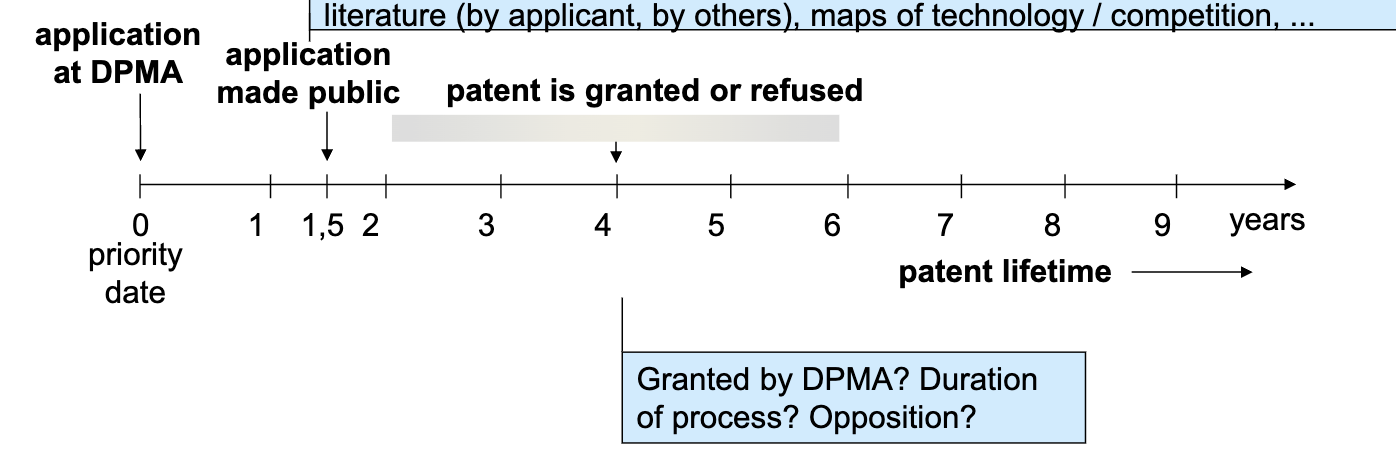
After submitting a patent application that describes the technical invention and defines the desired area of protection, the patent office examines the application for formal and substantive requirements. If the invention is patentable, the patent is granted and published. The average time from application to grant at the European Patent Office (EPO) is 4 years and the time limitation starts from the filing date. 18 months after filing, the application is published and becomes publicly accessible.
The patent owner must pay annual fees to maintain the patent’s validity. Granted patents can be renewed
for up to 20 years, or for pharmacological patents, up to 25 years in Germany.
Benefits and Costs
Aside
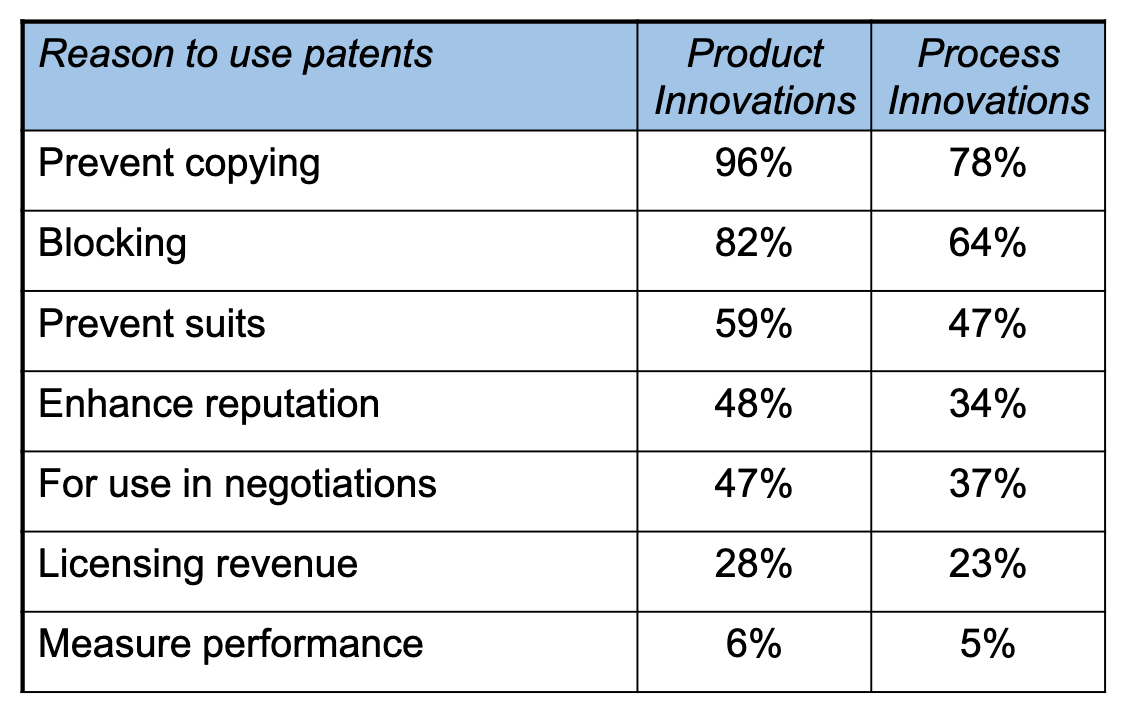
Using patents as a protection strategy provides benefits:
- Exclusive profits from use in production without risk of imitation, allowing for licensing or cross-licensing (patent exchange).
- Creates costs for rivals to imitate, as they must invest in R&D to develop alternative solutions.
- Especially for young firms, patents can be used to attract investors, as they signal innovation and potential market advantage.
However, there are also costs associated with patents:
- High costs for application, maintenance, and legal enforcement (attorney, research, application fees, renewal fees, translation costs, …).
- The application is made public, therefore secrecy is lost.
- Detecting infring parties can be difficult, and legal enforcement can be costly and time-consuming.
Having a patent granted at the EPO for 5 states costs around 9,000€ plus 4,000-14,000€ of attorney fees, with additional renewal fees later on.
Information for Competitors
Competitors can gain valuable information from patents, as they are published and publicly accessible. This allows competitors to:
- Analyze competitors’ technological developments and strategies (entry/exit in different technologies, R&D direction, patenting profile, …)
- Identify trends and forecasts technology breakthroughs.
- International market analysis.
- Valuation of technology assets (patent volume, shares, citations).
- Tracking key investors/actors in the field (patent owners, inventors, universities, …).
- Monitoring possibilities for inventions and infringements.
Societal Costs
- Dynamic Efficiency: Under suitable conditions, patents provide incentives for developing new technology. A limited period of potential monopoly power increases investment.
- Static Inefficiency: Granted patents provide exclusion rights, which can lead to an inefficient allocation of resources.
When Watt patented the steam engine, he prevented others from using it for 20 years, which slowed down the development of steam engines. During this time, Watt blocked others from improving the steam engine, serving as an example of how patents can hinder innovation. The patent system is a trade-off between incentivizing innovation and allowing for the free flow of ideas and competition.
Patent Infringements
Patent infringements must be found and brought to court by the patent holder. If the court finds that the patent is infringed, the patentee is entitled to:
- Injunction: The infringer must stop using the patented invention. This can be powerful if the infringer has invested in complementary assets to the patent.
- Damages: The infringer must compensate the patent holder for losses incurred due to the infringement. This can be lost profits, infringer’s profits, or a reasonable royalty.
Design Protection
For 2d or 3d appearance of part of or the whole product (product innovations, not processes). Designs must be new and have individual character. Registered designs are relatively cheap (min. 350€ for 5 years), can be held up to 25 years, and are registered nationally (except for EU-wide Registered Community Designs). They are published and publicly accessible, which allows competitors to analyze the design and potentially create alternative designs.
While design protections are not very strong (they are often difficult to enforce), they are cheap, simple, and may be attractive in combination with other mechanisms.
Trademarks
For brand names, logos, and other identifiers that distinguish goods or services (typically a series of products). Trademarks can be registered and renewed indefinitely, as long as they are in use. They can be registered nationally or at the EUIPO (min. 850€ for 10 years).
Trademark protection is relatively cheap but the mark must be used to maintain protection.
Copyrights
For original works of the expression of ideas, such as literature, music, and software. Unlike the other protection mechanisms, copyright is unregistered and arises automatically upon creation of the work. Copyright protection is relatively cheap, but it is often difficult to enforce, especially in the digital age where copying and distribution can occur easily. Public attitude towards copyright infringement is often lenient, which can make enforcement more challenging.
Copyrights last much longer, with most works protected for 70 years after the author’s death (even longer in the US).