Hand-crafted by Flo, auto-checked by AI.
Resources
Strategy is the determination of long-term goals to establish competitive advantage, as well as steps and resource allocation to attain them, considering reactions of other players. Changing strategy is typically costly and not possible in the short term, so there needs to be some room within the strategy.
- What’s the companies competitive advantage and how can it be sustained?
- What products or services should be offered in 5 years, and how much should be invested in R&D?
- Should the company be a technological pioneer or a follower?
Strategy Development
Strategy development integrates a companies strengths and weaknesses (internal) from the resource-based view with the opportunities and threats (external) from the market-based view. Much of this is also explained in Strategy Analysis.
Market-Based View (Porter’s Five Forces)
As explained in Market-Based View (MBV) Outside-In, the market-based view focuses on the external environment and how it affects the company’s competitive position. Porter’s Five Forces is a framework for analyzing the competitive forces in an industry, which include:
- Threat of new entrants: How easy is it for new competitors to enter the market?
- Bargaining power of suppliers: How much power do suppliers have to drive up prices?
- Bargaining power of buyers: How much power do customers have to drive down prices?
- Threat of substitute products or services: How likely is it that customers will switch to a substitute product or service?
- Rivalry among existing competitors: How intense is the competition among existing competitors?
The generic strategies to achieve a competitive advantage are:
- Cost leadership: Becoming the lowest cost producer in the industry.
- Differentiation: Offering unique products or services that are valued by customers.
- Focus: Targeting a specific market segment and tailoring products or services to that segment.
Resource-Based View
As explained in Resource-Based View (RBV) Inside-Out, the resource-based view focuses on the internal resources and capabilities of the company that can provide a competitive advantage. These resources must be:
- Valuable: They must enable the company to exploit opportunities or neutralize threats.
- Rare: They must not be widely possessed by competitors.
- Inimitable: They must be difficult for competitors to imitate.
- Non-substitutable: They must not have equivalent substitutes that can provide the same
If resources are valuable and rare, but not inimitable and non-substitutable, they can provide a temporary competitive advantage. If all factors are met, the competitive advantage can be sustained over time. The company must also have the organizational capabilities to effectively utilize these resources.
Resources could be inimitable if they are protected by effective IPR; secret; unique by nature; path-dependent; socially complex.
Capabilities
The organizational and managerial skills to organize resources and deploy them strategically, in addition to a company’s VRIN capabilities, these skills may be:
- Searching: The ability to identify and evaluate new opportunities and threats in the market.
- Selecting: The ability to choose the best opportunities and threats to pursue.
- Configuring: The ability to organize and deploy resources effectively to pursue the chosen opportunities and threats.
- Deploying: Delivering internally generated or acquired innovations on time and to budget.
- Learning: The ability to learn from past experiences and adapt to changing market conditions.
The skill to purposefully create, extend, or modify existing resources based on own capabilities is called dynamic capability.
For example, Honda uses its core capabilities in developing power trains (fluid flow, combustion, simulation, manufacturing) to deploy all kinds of devices with motors.
Key Pillars
A comprehensive innovation strategy needs to be tangible and cover the 5 relevant dimensions:
- Objectives define the company’s specific innovation objectives in line with long-term goals.
- Areas of focus identify the key technological or market areas where the company will concentrate its innovation efforts, thus defining what’s in or out of scope.
- Type of innovation and accepted risk specify whether the company wants to bet big (heavy investment aiming at radical invention), hedge bets (balanced investment aiming at incremental innovation), or wait and see (letting others take risks and imitating later).
- Budget and resources determine the financial and human resources allocated to innovation activities, ensuring strategic alignment.
- R&D organization defines the structure and processes for managing innovation, including how R&D teams are organized, how projects are selected and prioritized, and how innovation is integrated into the overall company strategy. For example, R&D can be centralized or decentrally innovate close to markets.
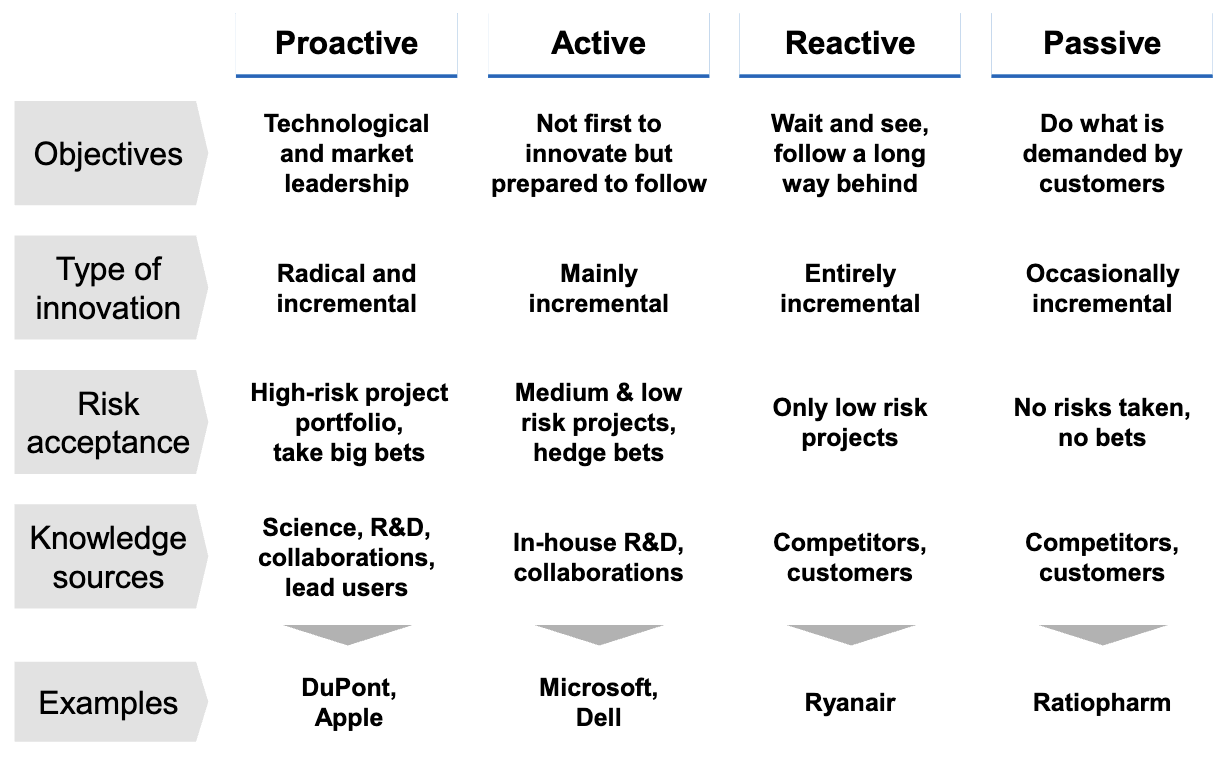
First-Movers and Late-Movers
As explained in First-Mover vs. Late-Mover, being a first-mover comes with some advantages and drawbacks. Upsides include technology leadership; preemption of scarce assets; switching costs and networks effects; buyer’s choice under uncertainty. Drawbacks include free-rider effects for others; resolution of technical/market uncertainty; shifts in customer needs; incumbent inertia.
Technology Push and Market Pull
Technology push is an innovation strategy that focuses on developing new technologies and then finding applications for them in the market. Market pull is an innovation strategy that focuses on identifying customer needs and then developing technologies to meet those needs.
Technology Push
Develop a technology, then seek ways to market it. This is often the result of basic research and can lead to breakthrough innovations and new demand creation. However, it may fail if the technology does not meet a real market need. Another issue is that this approach often focuses on what’s easiest to research.
Market Pull
Identify a market need, then develop a technology to meet that need. This approach is more likely to succeed because it is driven by customer demand, but it may lead to incremental innovations rather than breakthrough innovations, and once a solution is found, the company may be too focused on its application. Additionally, the market is locked into present products.
When marketing and science specialists work together, they can create a “technology-market fit” that combines the strengths of both approaches, leading to more successful innovation outcomes.