Resources
Modern innovation design moves beyond rigid pipelines by embracing Open Innovation to source external knowledge and accelerate development. Process success relies on strategic alignment, speed-to-market, and recognizing that high project attrition is a necessary filter rather than a failure.
Innovation Process
Ideally, innovation is a well-managed process that transforms ideas into marketable products or services. The innovation process is often visualized as a funnel, where many ideas enter, but only a few make it through to the end. This process is structured through Stage-Gate milestones , which serve as checkpoints for evaluating the progress and potential of each project.
Innovation Funnel
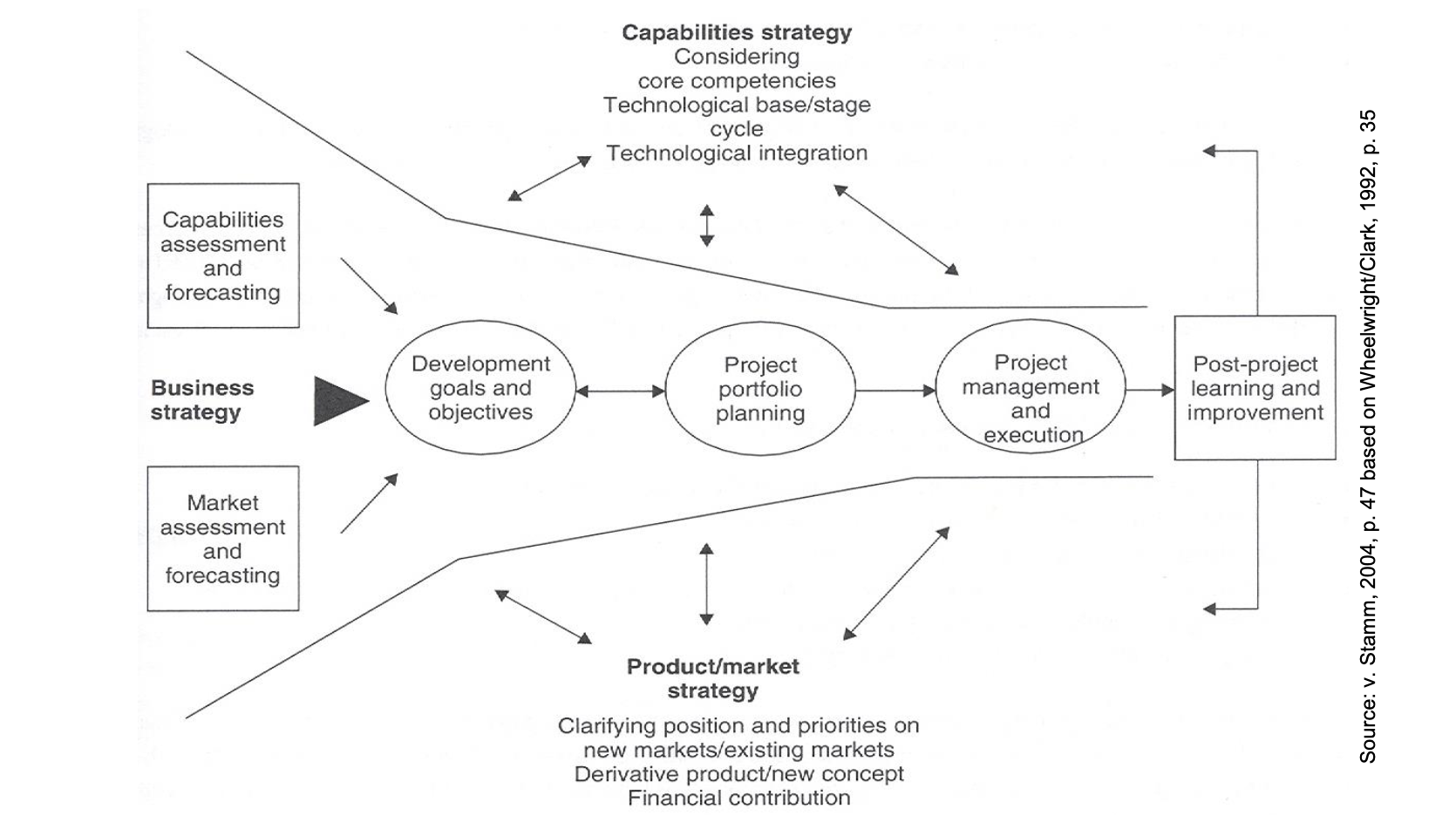
Both strategic linkages and operational flows of innovation can be represented as a funnel, where many ideas are generated, but only a few are selected for development and commercialization. The funnel metaphor illustrates the narrowing of options as projects progress through stages of evaluation and development.
In reality, the source of innovation is often uncertain, management might prefer suboptimal solutions, and the process is not always linear.
Strategic Alignment and Linkages
Strategic alignment ensures that innovation efforts are in line with the organization’s overall goals and objectives. This involves linking innovation projects to the company’s strategic priorities, market needs, and technological capabilities. The funnel represents the filtering of capabilities and market assessment down to development goals, portfolio planning, and project selection.
Operational Flow and Project Attrition
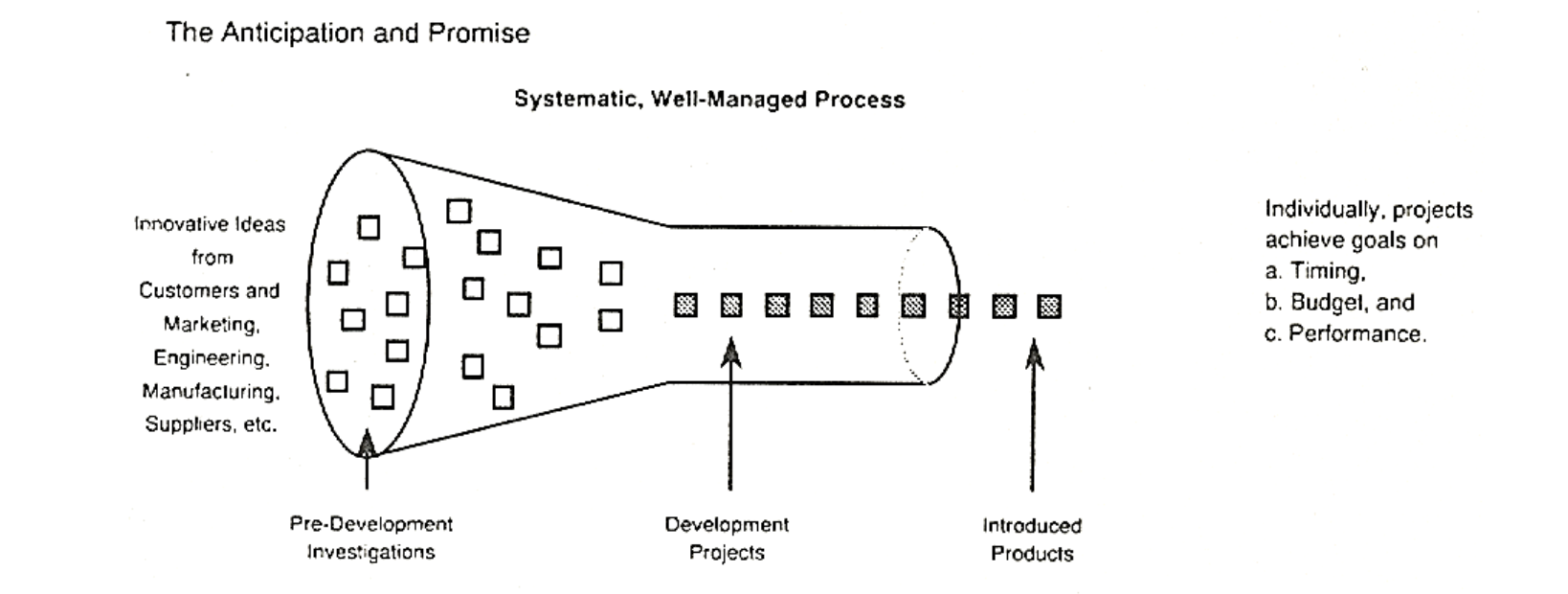
The operational flow of the innovation process involves the practical steps taken to develop and implement new ideas. This includes ideation, concept development, prototyping, testing, and commercialization. The funnel metaphor also illustrates project attrition, where many projects are initiated, but only a few survive through rigorous evaluation and resource allocation. This attrition is not a failure but a necessary part of the innovation process to ensure that only the most promising ideas reach the market.
Common Failures in Innovation
- Product/Service does not meet user needs or is priced too high for perceived value
- Does not meet technical or regulatory requirements
- Not sufficiently differentiated from competitors
- Too late to the market
- Lack of strategic alignment with the business portfolio
Stage-Gate Process
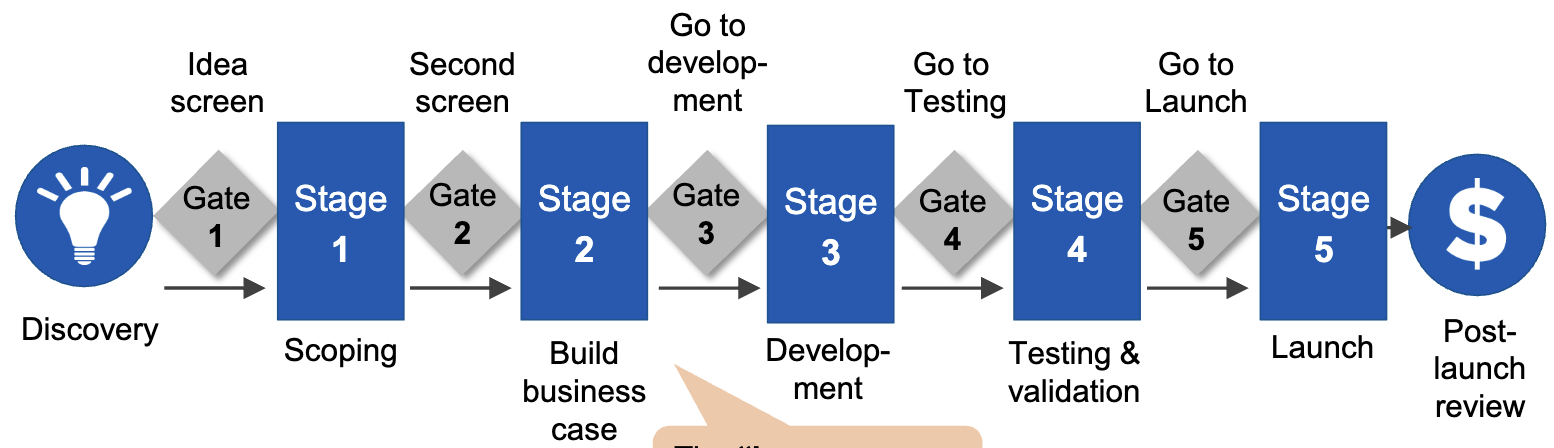
The Stage-Gate process is a structured approach to managing innovation projects, dividing the process into distinct stages separated by gates. Each gate serves as a decision point where projects are evaluated based on predefined criteria, and decisions are made about whether to continue, modify, or terminate the project.
Each stage consists of three activity types:
- Defined: Activities that are clearly defined and structured, such as market research or technical feasibility studies.
- Parallel: Activities that can be conducted simultaneously to accelerate development, such as prototyping and testing.
- Cross-Functional: Activities that require collaboration across different departments or functions within the organization, such as marketing, engineering, and finance.
.-
At each gate, projects are evaluated based on criteria such as strategic fit, market potential, technical feasibility, and financial viability, after which resources are allocated.
Good: The stage-gate process is a popular, wide-used tool to sharpen decision-making on many levels (project, portfolio, …) and reduces the escalation of commitment in new product development.
Bad: R&D is often political and the process can be hijacked (e.g. by management); criteria have to be well defined; less speed despite more work; the process might become an end in itself if not managed correctly. Incremental developments likely need a different stage-gate process than radical innovations.
Open Innovation
Open innovation is a paradigm that emphasizes the use of external ideas and knowledge to accelerate internal innovation processes. It encourages collaboration with external partners to leverage diverse perspectives and expertise. Visually, the tunnel is permeable.
- Inbound: Technology Acquisition Strategies: Internal R&D; Acquisition of firms; Joint ventures; Technology Purchasing; Technology Scanning
- Outbound: Technology Exploitation Strategies: Investment in production/marketing; Creation of units; Joint ventures; Divestment; Technology selling
Not Invented Here (NIH) Syndrome
NIH syndrome refers to the tendency of organizations to reject external ideas or innovations, favoring internally developed solutions. This can hinder the adoption of valuable external knowledge and limit the organization’s innovation potential.
To overcome this, Procter & Gamble integrated (among others) the Technology Entrepreneurs Network (to create external connections) and the Innovation Leadership Team (to manage internal innovation processes) and called it Connect & Develop (C&D): “Proudly found elsewhere”.
Measuring Performance in Innovation
- Productivity: Resources committed vs new products/services launched
- Speed to Market: Time between project start and commercialization
- Flexibility: Time between concept freeze and market introduction
- Quality: Overlap of the PSI (product/service innovation) quality function and the quality achieved
- Fit: Relationship between PSI outcome and strategic goals as well as market feedback